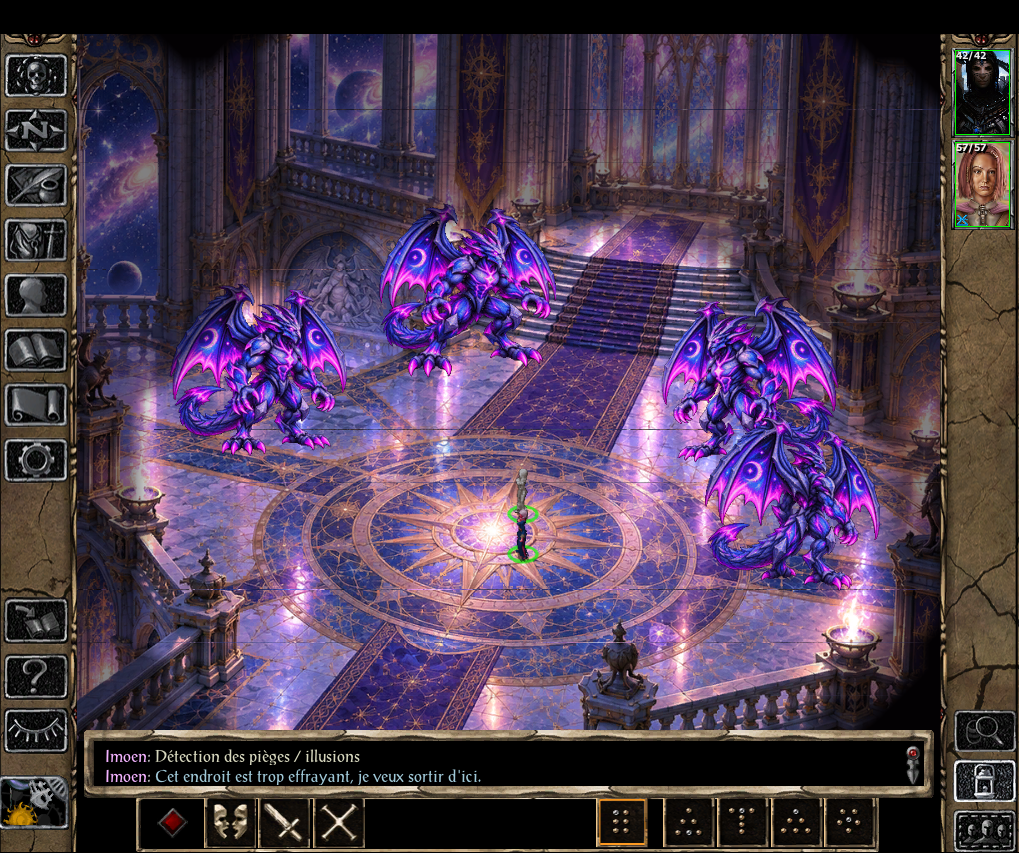
Breath of Fantasy banner
341 Unique Visitors 459 Views 52 Downloads
✧
DRAKHYSYS FANTASY ARCHIVES

Where legends breathe beyond the crystal sky.

A personal fantasy sanctuary for videos, chronicles, battles, worlds, music and entities.

All Chronicles
✦ PRIMARY POST ✦
✦
Server Status 2026-11-01

Baldur's Gate 2 & Neverwinter Nights 2 Onlines

Baldur's Gate 2 & Neverwinter Nights 2 Onlines

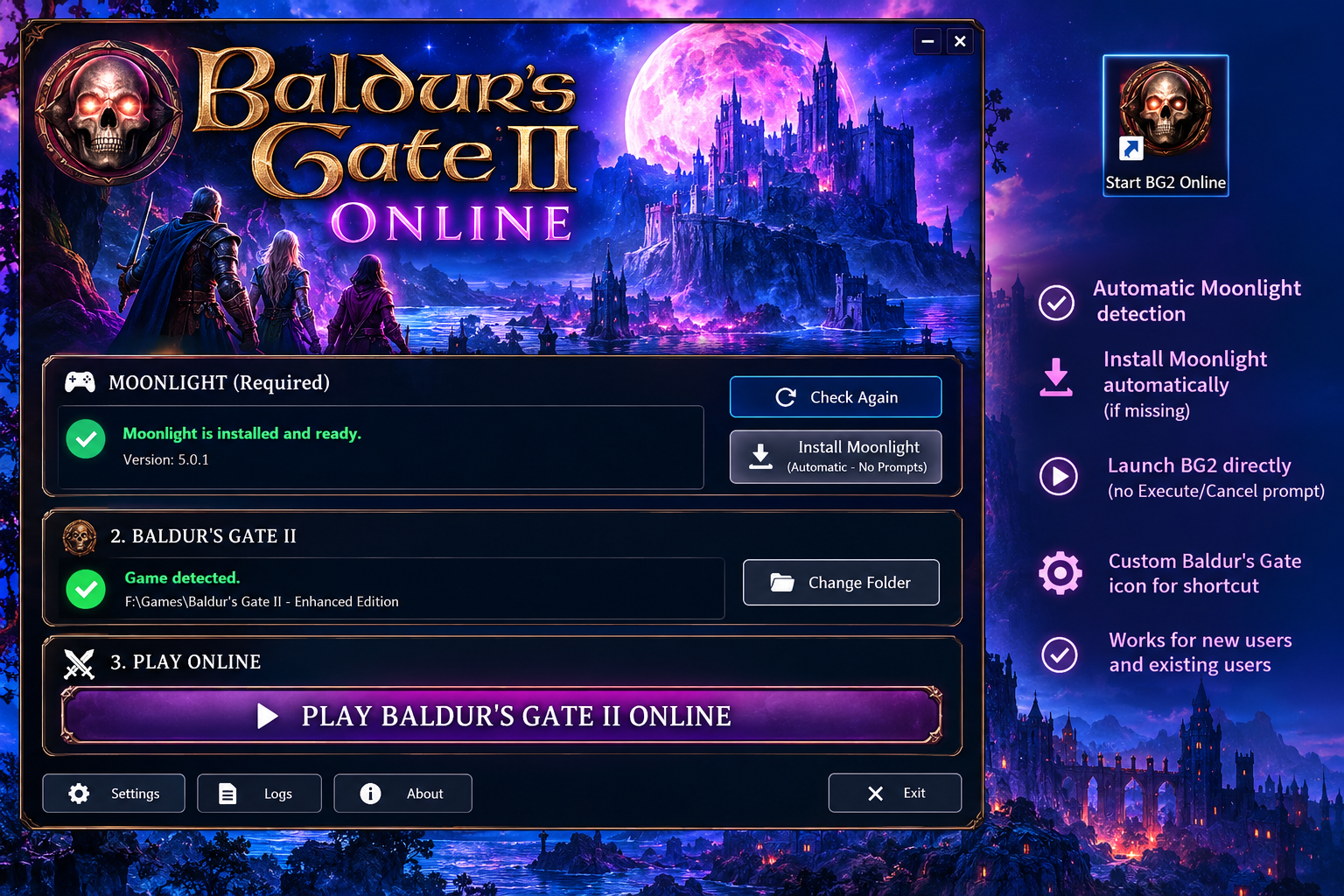
Baldur's Gate II Online Launcher

Return to the Forgotten Realms — Your Adventure Continues

Developed by Drakhysys | Breath of Fantasy

The legendary world of Baldur's Gate II returns with a new multiplayer launcher designed to bring players together and extend the possibilities of this classic role-playing adventure.

Inspired by the unforgettable GameSpy multiplayer era, Baldur's Gate II Online Launcher is a custom application developed to simplify game launching, player account management, character organization, and multiplayer sessions.

Whether you wish to revisit the Sword Coast, explore Amn, or experience the challenges of Throne of Bhaal, this launcher is designed to make returning to Baldur's Gate II multiplayer more convenient.

Features

Player Account System

Create and manage individual player accounts, with dedicated login and character-management functionality.

Character Management

Import and export Baldur's Gate II characters while keeping character selections organized by player account.

Multiplayer Launcher

Access the multiplayer environment through a custom launcher designed to simplify hosting and joining supported game sessions.

Campaign Selection

Support for the Baldur's Gate II campaign environment, including Shadows of Amn, Throne of Bhaal, and configured additional campaign content.

Player Identity and Character Ownership

Account-oriented character management helps preserve individual player identities within the multiplayer environment.

Classic Gameplay Experience

Experience the original Baldur's Gate II adventure and its Infinity Engine gameplay through a modern launcher interface.

Custom Software Development

Created using a combination of programming, game integration, and iterative testing to extend the usability of an unforgettable RPG.

A Tribute to the GameSpy Generation

There was a time when Baldur's Gate II multiplayer was more than a game.

It was a world of clans, rivalries, friendships, character experimentation, and unforgettable encounters.

Communities such as GOD, VAMP, and BORG became part of that early multiplayer history.

As a former participant under the names GOD_Cronos, Vamp_Cronos, and BORG_Kronos, I developed this launcher partly out of my desire to revisit that generation and preserve its memory.

The objective is not to replace Baldur's Gate II.

It is to give players another way to experience and enjoy it together.

Requirements and Important Information

A compatible, legally obtained installation of Baldur's Gate II is required. The launcher does not include the commercial game or its copyrighted assets.

Multiplayer requires compatible game installations and a properly configured host connection. Internet play may require additional networking configuration or supported remote-access software.

This is an independent, unofficial community project.

Breath of Fantasy

Baldur's Gate II Online Launcher is part of Breath of Fantasy, my collection of creative software, game-editing tools, and experimental projects.

My objective is to preserve the spirit of classic role-playing games while exploring new possibilities through software development.

The Forgotten Realms await. Gather your party, and let the adventure continue.

Created by Drakhysys

Breath of Fantasy — Preserving the Legacy of Classic Multiplayer RPGs

Unofficial fan-made software. Not affiliated with or endorsed by BioWare, Beamdog, Wizards of the Coast, or the respective rights holders.

Neverwinter Nights 2 Online Launcher

Beyond the Original Campaign — A World of Adventure Awaits

Developed by Drakhysys | Breath of Fantasy

Enter the Forgotten Realms once again with Neverwinter Nights 2 Online Launcher, a custom multiplayer launcher designed to expand the possibilities of one of the most ambitious classic Dungeons & Dragons role-playing games.

Created for players who enjoy persistent worlds, character development, multiplayer adventures, and customized gameplay, this project brings together game launching, account management, multiplayer configuration, and support for modified Neverwinter Nights 2 environments.

The goal is simple:

Make Neverwinter Nights 2 easier to customize, manage, and experience with other players.

Features

Custom Multiplayer Launcher

A dedicated application designed to launch Neverwinter Nights 2 and simplify access to configured multiplayer environments.

Individual Player Accounts

Manage separate player accounts and game environments through an account-oriented launcher system.

Multiplayer Connection Support

Join configured Neverwinter Nights 2 hosts using direct-connect functionality.

Local multiplayer environments are supported, while connections across the internet require appropriate network configuration.

Customized Game Settings

Support for account-specific configuration and modified game settings, allowing greater flexibility when managing the Neverwinter Nights 2 experience.

Character Customization

Designed to work with customized Neverwinter Nights 2 environments, including experimental character progression, appearance customization, and gameplay modifications.

Level 40 + Ascension System

An experimental character progression system built around a Level 40 cap, with an optional Ascension feature designed to let characters begin a new progression cycle.

At Level 40, eligible characters can choose Ascension, returning to Level 1 with 0 XP while retaining their previously acquired feats and spells, subject to the installed system's compatibility and limitations.

Custom Modules and Campaigns

Launch and explore compatible custom modules, campaigns, and multiplayer worlds.

Game Integration Tools

Developed around the practical challenges of managing an older game engine, including configuration files, installations, executable handling, and multiplayer setup.

Expanding the Forgotten Realms

My ambitions for Neverwinter Nights 2 extend beyond the launcher itself.

Through the separate NWN2 World Editor project, I have been experimenting with merging content from multiple campaigns and modules into larger, interconnected worlds.

This work includes:

  • Combining exterior and interior areas from different modules.

  • Preserving and organizing scripts, creatures, items, and placeables.

  • Rebuilding area transitions and connections.

  • Developing customized death and resurrection systems.

  • Creating creature encounters and respawning behaviors.

  • Experimenting with Level 40 character progression and Ascension mechanics.

  • Customizing character appearances, equipment visuals, and permanent cosmetic styles.

  • Customizing PvP rules and multiplayer gameplay.

These world-editing systems are separate development work and are not necessarily included with the launcher download.

Together, the projects reflect my vision of a larger, more customizable Neverwinter Nights 2 experience.

Level 40 + Ascension — A New Path to Power

One of my interests in game development is exploring how character progression and gameplay systems can be expanded beyond conventional limitations.

My experimental Neverwinter Nights 2 environment uses a Level 40 progression cap combined with an optional Ascension system.

Rather than extending ordinary leveling indefinitely, Ascension is designed to introduce a new cycle of character development.

Upon reaching Level 40, eligible players can voluntarily activate Ascension:

  1. Reach Level 40: Complete the current character progression cycle.

  2. Activate Ascension: Choose to begin a new journey.

  3. Return to Level 1: The character restarts at Level 1 with 0 experience points.

  4. Preserve Acquired Abilities: The system is designed to retain feats and spells earned during the previous cycle.

  5. Progress Again: Continue developing the character through a new leveling cycle.

The goal is to create an evolving character-development experience in which reaching Level 40 can become a new beginning rather than the end of progression.

These modifications require compatible game files, server configuration, scripts, and module settings. Ascension remains experimental, and full compatibility with every class, feat, and spell is not guaranteed.

My objective is to explore new gameplay possibilities while respecting the technical realities of the Neverwinter Nights 2 engine.

Inspired by the Original Multiplayer Generation

My connection to the Forgotten Realms began long before the development of this launcher.

During the GameSpy era, I participated in the Baldur's Gate II multiplayer community under the names GOD_Cronos and Vamp_Cronos.

Later, I entered the world of Neverwinter Nights through Shadows of the Sword Coast, where I was known as Zerial Solcrisis.

Those experiences helped develop my interest in multiplayer communities, customized characters, scripting, and the creation of persistent worlds.

Many years later, I returned to these ideas with modern programming tools.

Neverwinter Nights 2 Online Launcher is part of that continuing journey.

Requirements and Important Information

A compatible, legally obtained installation of Neverwinter Nights 2 is required. The launcher does not include the original commercial game or its copyrighted resources.

Multiplayer requires a compatible game installation and an available host. Internet connectivity may require router, firewall, VPN, or other networking configuration.

Modified game modules, Level 40 progression, and Ascension features may require additional compatible files and server-side installation. These features are experimental and are not necessarily included with the standalone launcher.

This project is unofficial and independently developed.

Breath of Fantasy

Neverwinter Nights 2 Online Launcher represents my continuing fascination with programming, multiplayer systems, worldbuilding, and the customization of classic role-playing games.

My objective is to preserve the worlds that inspired me while developing new tools that allow players to explore them differently.

The Forgotten Realms are vast. Your adventure does not have to end with the original campaign.

Created by Drakhysys

Breath of Fantasy — Gaming, Software Development & Forgotten Realms Legacy

Unofficial fan-made software. Not affiliated with or endorsed by Obsidian Entertainment, Atari, Wizards of the Coast, or the respective rights holders.

✦
Status 2026-11-08

NWN2 & BG2 Project

I abandon the Online project for the moment, there will be no online update until it will be fixed.
✦
Server Status 2026-11-05

Server Host

Server Host
There is no online available.
✦
Legends of Neverwinter Nights 2026-11-03

Neverwinter Nights Online Infinity

Neverwinter Nights Online Infinity

NEVERWINTER NIGHTS 2 ONLINE INFINITY

RISE OF THE BEASTS

Created and edited by Drakhysys

One World. Hundreds of Areas. Endless Adventures.

Rise of the Beasts is an ambitious custom multiplayer world built using Neverwinter Nights 2, combining content from 20 modules into a massive interconnected Forgotten Realms adventure.

Created around exploration, survival, dangerous encounters, character progression, and player freedom, the server transforms the traditional NWN2 experience into a challenging open-world RPG.

A Massive Fantasy World

The world features hundreds of areas originally taken from Neverwinter Nights 2 campaigns and their modules, brought together into one enormous interconnected adventure.

These campaign environments have been merged, adapted, and repurposed to create a unified world, preserving the atmosphere and architectural diversity of the original adventures.

Explore vast forests, mountains, deserts, ancient ruins, underground civilizations, dangerous dungeons, bustling cities, villages, castles, and mysterious planes of existence.

Every region has its own atmosphere, inhabitants, and dangers. Cities and settlements are not automatically safe, and powerful creatures can be encountered throughout the world.

Extended Character Progression — INFINITE LEVELS

Unlike the original Neverwinter Nights 2 campaigns, which normally restrict character progression to level 20 or 30 depending on the expansion, Rise of the Beasts is configured for a maximum character level of 40 with ascension.

This expanded progression system is designed to support extremely powerful characters, long-term advancement, and increasingly challenging adventures far beyond the original game's progression limits.

Living Creatures and Dangerous Encounters

Wildlife, giants, trolls, ogres, drow, driders, mind flayers, elementals, dragons, powerful spellcasters, and many other creatures populate environments suited to their nature.

Encounters are designed around smaller groups of stronger enemies, with respawning creatures, powerful bosses, and unique challenges for experienced characters.

Death Has Consequences

Death is a meaningful part of the experience.

When a character dies, they lose 80% of their carried gold permanently, leave their equipment in a corpse container, and travel to the mysterious Fugue Plane.

There, the Angel of Death offers two paths:

  • Resurrection: Pay 150 gold to return to the location of death.

  • Free Return: Return to the starting location without paying.

Recovering lost equipment becomes part of the adventure.

Open-World PvP

The world embraces danger and player freedom. PvP is enabled throughout the world, including cities and wilderness regions.

Only the Fugue Plane and the starting Church of Tyr are designated PvP-safe areas.

Local Multiplayer — Private Server Experience

Rise of the Beasts is designed primarily for private, locally hosted multiplayer rather than public Internet matchmaking.

The intended audience consists of players using the custom NWN2 account system to participate in a privately controlled multiplayer world, particularly players running multiple game clients or accounts on the same computer.

The server is configured for direct connections through 127.0.0.1:5121, allowing game clients running on the host computer to connect without using an external Internet address.

This configuration provides:

  • Private multiplayer sessions under the host's control.

  • Support for separate player accounts and game instances.

  • Direct localhost connectivity without public server listings.

  • A self-hosted world intended for personal gameplay, testing, and private adventures.

  • No requirement for an external public game server.

The localhost address is accessible only from the hosting computer. Allowing friends on other computers on the same local network would require additional LAN configuration and the host's private network IP address.

The project is therefore best described as a self-hosted, private multiplayer RPG world, rather than a publicly accessible MMORPG.

Custom Multiplayer Experience

The project incorporates a custom account-based game setup, individual player configurations, English and French language options, and direct multiplayer connectivity.

Its private hosting architecture gives the owner control over the game environment, characters, world configuration, and gameplay systems.

A World Built for Adventure

Rise of the Beasts brings together environments from numerous NWN2 campaigns, exploration, combat, survival, creature ecology, powerful enemies, extended character progression up to level 40 with ascension, and custom gameplay systems into a single private multiplayer experience.

An enormous Forgotten Realms world where exploration is rewarded, danger is everywhere, and every death carries a price.

Neverwinter Nights 2 Online — Rise of the Beasts

Transformative Edit by Drakhysys

Thanks to chatgpt and claude code and the legendary community skywing who made my dreams possible.

✦
Knowledge of The Ancients 2026-11-01

Neverwinter Vault

Open Link ↗
✦
About Me. 2026-10-31

Drakhysys/Kronos

Drakhysys/Kronos

Drakhysys — The Personality Behind the Creation

Independence, Imagination, Determination, and the Pursuit of Creative Freedom

Beyond Audio, Gaming, and Technology — Understanding the Person Behind Breath of Fantasy

A Personality Driven by Curiosity

I have always been someone who wants to understand things beyond their surface.

Whether I am working with sound, experimenting with software, modifying a video game, or studying the behavior of a complex system, I rarely feel satisfied with simply knowing that something works.

I want to understand why it works, how it works, and whether it can work differently.

This curiosity is one of the strongest influences on my personality.

I do not particularly enjoy accepting limitations without understanding their reasons. When something appears impossible, my natural reaction is often to investigate whether that limitation is truly unavoidable.

Sometimes the answer is that a system has genuine technical restrictions.

Other times, an alternative method can be discovered.

For me, the value lies in exploring the possibilities rather than immediately accepting the first answer.

This attitude has influenced my interests in audio processing, programming, game modification, and creative experimentation.

Independence — The Need for Creative Freedom

One of the most important aspects of my personality is my desire for independence.

I prefer having the freedom to explore ideas according to my own vision rather than being restricted to conventional approaches.

This does not mean that I reject every rule or technical limitation.

It means that I want to understand whether those boundaries are necessary and what possibilities exist beyond them.

When existing software does not provide the functions I need, I may attempt to develop my own.

When a game imposes limitations on character progression or customization, I become interested in understanding whether those restrictions can be changed.

When a creative tool cannot produce the transformation I imagine, I begin looking for another approach.

I want technology to serve creativity, rather than allowing existing technology to define the limits of my imagination.

That desire for independence has become an important part of my identity.

Determination — Refusing to Abandon an Idea Easily

I can be extremely persistent when pursuing something that matters to me.

A technical problem may require numerous experiments, revisions, and unsuccessful attempts before a workable solution emerges.

I do not always enjoy that process.

Repeated failures can make me impatient, especially when a problem appears to have been resolved only to return unexpectedly.

Nevertheless, I often continue experimenting.

My work on audio-processing software, custom applications, and Neverwinter Nights 2 world development reflects this tendency.

Complex projects can involve unexpected behavior, conflicting resources, broken references, compatibility problems, and limitations that are difficult to overcome.

I may become frustrated, but frustration does not necessarily mean that I have abandoned the objective.

Quite often, it means that I still care strongly about achieving it.

My determination is both a strength and something I must learn to manage.

Persistence helps me continue developing difficult projects.

However, recognizing when an approach needs to change can be just as important as refusing to give up.

Imagination — Seeing Possibilities Beyond What Already Exists

Creativity is another defining part of how I approach the world.

I am not interested only in reproducing what has already been created.

I enjoy imagining how existing material might be transformed into something different.

In audio, this means experimenting with sound layers, effects, spatial processing, and unusual transformations.

In gaming, it means imagining larger worlds, different progression systems, customized mechanics, and experiences that extend beyond conventional campaigns.

In software development, it means designing tools around functions that I would personally like to use.

These interests are connected by a common desire:

To take something that already exists, explore its possibilities, and transform it into something personal.

My imagination does not always move at the same pace as my technical abilities.

Sometimes I can envision a result long before I understand exactly how to implement it.

That difference between imagination and implementation becomes part of the challenge.

It encourages me to learn.

High Standards — The Desire to Make Things Work Properly

I have high expectations for the projects that matter to me.

When something is supposed to function, I want it to function reliably.

I am not easily satisfied by a solution that appears successful but leaves important problems unresolved.

This can make me demanding, especially during software development.

I may insist on correcting small details because I know that seemingly minor problems can eventually affect an entire system.

My preference is for solutions that are coherent, practical, and consistent with the original objective.

However, this attitude can also create difficulties.

I may become impatient when progress is slower than expected or when repeated attempts fail to address the underlying problem.

Learning to distinguish between essential improvements and less important imperfections is therefore an ongoing part of my development.

My standards can help improve the quality of my work, but they also require patience.

Honesty — A Direct Way of Expressing Myself

I tend to communicate directly, particularly when discussing technical problems.

When something does not work, I prefer to say so rather than pretend that the result is satisfactory.

I value clear explanations, practical solutions, and an accurate understanding of what has been accomplished.

I would rather acknowledge that a particular method has failed than continue treating it as successful.

This directness can sometimes make my communication appear abrupt, especially when I am frustrated.

Yet my intention is generally to resolve the problem and continue making progress.

I also value honesty when looking back at my own experiences.

I do not believe that every decision I made in the past was necessarily correct.

There are moments when I can recognize that pride, frustration, or ambition influenced my behavior.

Acknowledging those moments is important to me because personal history should not consist only of achievements.

It should also include the lessons learned along the way.

Loyalty — Remembering the People Who Mattered

My experiences with GOD, VAMP, and BORG reveal another important aspect of my personality: the significance I attach to loyalty, respect, and personal history.

During the early Baldur's Gate II multiplayer era, I was known as GOD_Cronos.

One of the people I remember most strongly from that period is GOD_Kid.

Although others expressed unfavorable opinions about him, I did not necessarily share those judgments.

My respect and devotion toward him remained meaningful even after I left GOD Clan and joined VAMP.

Later, as Vamp_Cronos, I developed a profound attachment to VAMP itself.

Changing communities did not automatically erase the importance of those that came before.

For me, loyalty is not always a matter of remaining permanently associated with one organization.

It can also mean remembering people with respect, recognizing their influence, and refusing to dismiss the past simply because circumstances have changed.

I can move forward without believing that everything behind me must be forgotten.

Pride, Rivalry, and Self-Reflection

My personality also contains contradictions.

I can be competitive and proud of what I have learned.

I want to improve my abilities and sometimes find it difficult to accept that someone else may be more accomplished than I am.

My recollections of BORG_Kaos are an example.

During the original multiplayer era, I struggled to acknowledge his exceptional abilities.

My pride sometimes influenced the way I behaved toward him, and I have since recognized that he did not deserve that treatment.

Looking back, I can acknowledge that my frustration was not a justification.

This experience taught me something about the relationship between ambition and respect.

Wanting to become better does not require diminishing someone else's abilities.

Recognizing another person's achievements does not invalidate my own experiences.

I cannot change every decision I made in the past.

But I can reconsider those decisions and choose how I remember them today.

For me, the ability to acknowledge a mistake is more valuable than pretending I never made one.

Emotional Attachment — More Than Technical Interests

Although much of my work revolves around technology, programming, and creative experimentation, those interests are not entirely detached from emotion.

I can develop strong attachments to projects, communities, and the memories associated with them.

An old multiplayer clan may appear insignificant to someone who never experienced it.

To me, however, it can represent years of competition, ambition, friendship, rivalry, and personal development.

Likewise, creating an audio editor is not simply a programming exercise.

It represents time, effort, imagination, and the satisfaction of building something that reflects my own ideas.

This emotional investment can strengthen my determination.

It can also make failures and disappointments more difficult to accept.

The things I create often carry personal meaning beyond their practical functions.

An Experimental Mind — Learning Through Experience

My preferred approach to learning is strongly connected to experimentation.

I often develop an idea, test it, examine the result, and make changes according to what I discover.

This process can involve numerous revisions.

I do not always begin with a complete theoretical understanding of every system.

Instead, I combine practical exploration with research, programming, testing, and continuous improvement.

Over time, this has encouraged me to become more comfortable working across several technical disciplines.

Audio editing introduced me to signal processing and sound transformation.

Software development expanded my understanding of programming, automation, and graphical interfaces.

Game editing introduced additional challenges involving resources, scripts, modules, and multiplayer systems.

Each field contributed to the development of the others.

I have learned that curiosity becomes particularly useful when it is combined with patience, testing, and a willingness to revise assumptions.

Ambition — The Desire to Create Something Meaningful

My ambitions are not limited to completing individual technical tasks.

I also want my projects to have meaning.

Through Breath of Fantasy, I have attempted to bring together creative work, technical development, and the preservation of memories from an earlier gaming generation.

I do not want to claim achievements that belong to other people or present myself as the owner of communities whose history extends beyond my own participation.

Instead, I want to preserve my perspective while acknowledging the contributions of those who came before me.

I want my work to reflect both my creativity and my respect for the people and experiences that influenced it.

This includes remembering Vamp_Philip as the founder of VAMP, BORG_FlashRam as the person who later revived it, and the various players, developers, and Dungeon Masters whose activities helped shape the community.

Preserving their names is one way of recognizing that individual creativity often develops through contact with other people.

My Strengths and My Challenges

I see several qualities that influence the way I work and interact with others.

My strengths include curiosity, imagination, independence, persistence, technical experimentation, direct communication, and loyalty toward the people and experiences that matter to me.

I am willing to explore unfamiliar systems and invest considerable effort in understanding them.

I can maintain an interest in a project through repeated setbacks, especially when I believe the original idea remains worth pursuing.

At the same time, these qualities have their difficulties.

My determination can become stubbornness.

My high expectations can turn into impatience.

My competitiveness can sometimes become excessive pride.

And my emotional investment can make it difficult to accept outcomes that do not match what I had imagined.

I do not believe that recognizing these tendencies diminishes my strengths.

Instead, understanding them can help me use those strengths more effectively.

Determination is most valuable when it remains open to learning.

Independence is most useful when it does not prevent cooperation.

And confidence becomes more meaningful when it can coexist with humility.

The Personality Behind Breath of Fantasy

Breath of Fantasy represents several aspects of my personality coming together.

It reflects my curiosity about technology, my interest in creative transformation, my determination to develop independent tools, and my attachment to the history of the communities that influenced me.

My journey has moved through different identities and disciplines.

I was GOD_Cronos during an early chapter of Baldur's Gate II multiplayer.

I became Vamp_Cronos, an Ancilla of VAMP.

I lived as Zerial Solcrisis in Shadows of the Sword Coast.

I later became BORG_Kronos.

Today, I work under the name Drakhysys.

Each identity belongs to a different period, but they are connected by a continuing desire to learn, experiment, improve, and create.

I do not consider myself someone who has mastered everything I attempt.

There are still many things I do not understand, and many ideas that remain difficult to realize.

But I am willing to continue exploring them.

That willingness is perhaps one of the clearest expressions of my personality.

Drakhysys — Beyond the Projects

I am curious, but I can be impatient.

I am determined, but I can be stubborn.

I value independence, but I also recognize the importance of people who have influenced my journey.

I am proud of what I accomplish, yet I can look back and acknowledge mistakes.

I can be demanding because the things I create matter to me.

I am attached to the past, but I do not want to remain trapped within it.

I want to preserve memories while continuing to build something new.

I do not seek creative freedom because I believe everything is possible.

I seek it because I want to discover what is possible.

My personality is not defined entirely by the software I develop, the games I modify, or the names I have used.

Those are expressions of something deeper: curiosity, imagination, determination, attachment, and the desire to turn ideas into reality.

I am still learning.

I am still experimenting.

And I am still evolving.

I am Drakhysys — the person behind Breath of Fantasy.

Written as a personal portrait of Drakhysys, based on his creative projects, expressed values, and recollections.

Breath of Fantasy — Creativity, Independence, Memory & Evolution

✦
Realm of the Gods 2026-10-13

BORG_Kaos — A Legend of Baldur's Gate II

BORG_Kaos — A Legend of Baldur's Gate II

BORG_Kaos — A Legend of Baldur's Gate II

In Memory of a Legendary Player from the GameSpy Era

The Legend of BORG_Kaos

There was a time when Baldur's Gate II was more than an adventure set in the Forgotten Realms. During the legendary GameSpy multiplayer era, it became a world of fierce competition, powerful clans, unforgettable rivalries, and friendships forged through countless battles.

Players built their reputations through dedication, experience, strategy, and exceptional skill. Some became respected opponents, while others left an impression that would endure long after the multiplayer servers fell silent.

Among those remembered names stands BORG_Kaos.

For BORG_Kronos, a fellow player from that era, Kaos was more than simply another member of the multiplayer community. He represented a level of ability that was difficult to ignore and, at times, even harder to accept.

His skill challenged not only other players but also the pride of those who believed they had already mastered the game.

Rivalry, Pride, and a Difficult Truth

Competition has always been part of the spirit of Baldur's Gate II multiplayer. Victory brought recognition, defeat brought frustration, and the strongest opponents often earned both admiration and resentment.

Looking back on his encounters with BORG_Kaos, BORG_Kronos acknowledges something personal about their history.

"I wasn't always fair to BORG_Kaos. Sometimes I was rude to him, and although I had my reasons at the time, they were never good excuses.

The truth is that I struggled to accept that someone else could be better than me. I had invested so much time and effort into the game that recognizing his exceptional abilities was difficult for my pride.

My frustration sometimes influenced the way I treated him, and he didn't deserve that.

Today, I can look back and acknowledge what I couldn't fully accept then: BORG_Kaos was an exceptional player, and I should have shown him the respect he deserved."

Such an admission is more than a reflection on an old rivalry. It is a recognition that genuine respect sometimes requires overcoming one's own pride.

True skill does not become less impressive simply because it challenges our confidence. Likewise, recognizing another player's greatness does not erase our own accomplishments.

A Name That Deserves to Be Remembered

The GameSpy era has long since passed, but its history survives through the memories of those who experienced it.

Many battles were fought, countless characters were created, and rivalries developed between players who spent years exploring the possibilities of Baldur's Gate II.

While much of that history was never formally recorded, the names of certain players continue to carry meaning.

BORG_Kaos is one of those names.

He is remembered not merely as a rival or an opponent, but as someone whose remarkable abilities earned lasting recognition from those who encountered him.

His legacy is not defined by statistics, recorded victories, or titles alone. It is preserved in the respect of other players, including those who once found it difficult to acknowledge his talent.

Beyond Rivalry — A Tribute to BORG_Kaos

Time changes the way we remember competition.

What once seemed like an important defeat can become a valuable lesson. What once inspired frustration can eventually become admiration. And someone we once considered a rival can become a person whose memory deserves to be honored.

For BORG_Kronos, remembering BORG_Kaos is also an opportunity to recognize past mistakes and express the respect that should have been shown many years ago.

The battles may be over, the GameSpy servers may be gone, and the community may have scattered, but the memories remain.

BORG_Kaos deserves his place among the legends of Baldur's Gate II multiplayer.

Not because every battle has been documented or every achievement preserved, but because his abilities left an impression strong enough to survive the passing of time.

And sometimes, that is the greatest legacy a player can leave behind.

Dedicated to BORG_Kaos, in recognition of his exceptional skill, his place in the history of Baldur's Gate II multiplayer, and the lasting memories of the GameSpy generation.

A personal tribute by BORG_Kronos

Some players win battles. Others leave a legacy.

✦
Realm of the Gods 2026-09-19

VAMP & BORG

VAMP & BORG

VAMP & BORG — The Forgotten Legacy of Baldur's Gate II

From the GameSpy Era to Shadows of the Sword Coast — A History Revived by Vamp_Cronos, Now Known as Drakhysys

The Origins of a Forgotten Community

Long before modern gaming platforms, integrated modding tools, and online communities became commonplace, a generation of players was already pushing the boundaries of what video games could offer.

During the early multiplayer era of Baldur's Gate II, particularly through GameSpy, players formed clans, developed rivalries, experimented with character editing, and discovered ways to transform the game's combat systems.

Among these communities were two names that deserve to be remembered:

VAMP and BORG.

These were more than ordinary gaming clans. They belonged to a small but remarkable culture of players who sought to understand, modify, and master the games they played.

Character editing, scripting, hotkeys, automated combat sequences, and unconventional gameplay techniques became part of their identity.

For some, the objective was victory in multiplayer combat. For others, it was the challenge of discovering what could be achieved beyond the game's original limitations.

Over time, much of this history disappeared.

GameSpy eventually closed, personal websites vanished, forums went offline, and countless character files, scripts, and records were lost.

What remains is a fragmented history preserved through former participants' memories, surviving forum discussions, archived development credits, and traces of the Neverwinter Nights community.

This is an attempt to bring those fragments together, preserve the names of those who participated, and honor a generation of players whose creativity deserves recognition.

The Beginning — Baldur's Gate II and the Art of Scripting

One of the most valuable surviving personal accounts comes from BORG_DealerOfDeath, a former member who returned years later to describe the techniques and traditions of the original clans.

In his recollections, DealerOfDeath mentioned an early BORG figure known as Don, whose technical experimentation left a considerable impression.

Don reportedly possessed an edited character script capable of executing a lethal combat sequence through a single hotkey.

At a time when such techniques were unfamiliar to many players, this represented an extraordinary demonstration of what character scripting could achieve.

DealerOfDeath recalled that witnessing this kind of customization inspired him to begin studying character editing and scripting himself.

The most technically advanced players were not merely creating characters with exaggerated statistics. They were exploring automated combat routines, customized behaviors, and scripts embedded into character files.

They were learning to manipulate the game's underlying systems in ways that ordinary gameplay never anticipated.

This experimentation became one of the defining characteristics of the VAMP and BORG communities.

BORG — The Elite of the Multiplayer Era

Within this emerging culture, BORG developed a reputation for exceptional technical ability and advanced scripted combat.

According to DealerOfDeath's recollections, admission into BORG was highly selective.

Becoming a member was not simply a matter of adopting a clan name. It required proving one's knowledge, abilities, and dedication.

DealerOfDeath himself began as a member of VAMP before eventually earning a place among BORG.

He recalled that only two members of VAMP successfully advanced into BORG during the period he described.

Among those who helped him develop his skills was BORG_FlashRam, whom he remembered as an important mentor.

Although a complete original membership roster has not survived in the available historical material, several names remain particularly significant:

  • Don — Remembered for his early innovations in character scripting and automated combat.

  • BORG_FlashRam — A respected mentor and an important connection between the Baldur's Gate II and Neverwinter Nights communities.

  • BORG_DealerOfDeath — A former VAMP member who eventually advanced into BORG.

  • An additional unnamed VAMP member — Identified by DealerOfDeath as the other player who successfully progressed into BORG.

These accounts suggest that BORG functioned as an exclusive circle of technically accomplished players, where editing knowledge, scripting expertise, and combat effectiveness were highly valued.

Its reputation became part of the competitive identity of that generation.

VAMP — The Path Toward Mastery

Alongside BORG stood VAMP, a clan that played an important role in the development of aspiring players.

According to the surviving recollections, VAMP provided an environment where members could improve their abilities, experiment with editing techniques, and potentially earn recognition within the wider community.

For certain members, progressing into BORG represented the highest achievement.

It was within this world that my own history began.

During the final period of the Baldur's Gate II multiplayer era, I was known as Vamp_Cronos.

I belonged to VAMP and held the rank of Ancilla.

Like many others, I wanted to improve, demonstrate my abilities, and advance within the hierarchy.

I hoped that one day I might reach BORG.

I never did.

Yet that experience remained important to me.

VAMP was not merely a tag attached to my multiplayer identity. It represented a community in which dedication, experimentation, rivalry, and the pursuit of greater knowledge carried genuine meaning.

Those years helped shape my interest in game systems, editing, customization, and technical creativity.

Although no independently indexed surviving archive containing my exact Vamp_Cronos handle has yet been recovered, my participation and rank are part of my personal recollection of that period.

And those memories deserve to be preserved alongside the surviving historical records.

FlashRam — A Bridge Between Two Generations

One of the most important names connecting the original Baldur's Gate II community with the later Neverwinter Nights era is FlashRam.

DealerOfDeath remembered him as BORG_FlashRam, a mentor who helped him develop the knowledge necessary to progress within the editing and scripting community.

In later Neverwinter Nights records, FlashRam appears under the name Vamp FlashRam, identified as J. Anderson.

He is credited as the original creator of the persistent world Shadows of the Sword Coast, commonly known as SotSC.

According to the surviving project history, FlashRam initially established the server as a player-versus-player arena.

Together with X-Unknown, he served as one of its first Dungeon Masters.

FlashRam's appearance in both generations makes him an especially important figure in tracing the transition from the Baldur's Gate II editing culture to the more ambitious persistent-world projects that followed.

Through his work, part of the spirit of VAMP and BORG continued into a new game and a new technological era.

March 2003 — The Birth of Vamp Team

In March 2003, the development of Shadows of the Sword Coast underwent a major transformation.

According to the surviving SotSC history, a development team was assembled from members of an older Baldur's Gate II modding group.

This marked an important continuation of the earlier community.

What began as a relatively simple PvP arena evolved into an ambitious persistent world incorporating roleplaying, unrestricted PvP, permanent death, and Dungeon Master-controlled storylines.

The development organization became known as Vamp Team.

Its members brought forward the experience, creativity, and technical interests that had characterized the original editing scene.

However, their ambitions had expanded.

Instead of modifying individual characters and combat scripts, they were now creating entire environments, gameplay systems, adventures, and persistent multiplayer experiences.

The work involved level design, scripting, worldbuilding, balancing, server administration, and the development of rules that shaped a living online world.

In this sense, the earlier community did not simply disappear.

It evolved.

Shadows of the Sword Coast — A Living Forgotten Realms World

Shadows of the Sword Coast (SotSC) became one of the most substantial surviving legacies associated with Vamp Team.

Built within the world of Neverwinter Nights, it drew inspiration from the Forgotten Realms and its established locations, characters, and factions.

SotSC combined hardcore roleplaying with unrestricted PvP, permanent character death, and ongoing stories shaped by its Dungeon Masters.

The early Dungeon Master team documented around 2003 included Confuzion, FlashRam, X-Unknown, Democritus, and Myrkul.

Following the release of Hordes of the Underdark, the server was temporarily taken offline to undergo extensive reconstruction.

The surviving project history describes significant improvements, including the addition of several hundred areas, revised gameplay balance, changes to server rules, and an increase in player capacity from 32 to 64.

At the height of its popularity, SotSC reportedly attracted approximately 50 to 60 simultaneous players.

It was no longer simply an arena where opponents gathered to fight.

It had become a persistent world with its own community, stories, challenges, and shared history.

For those who participated, it represented something that existed beyond the boundaries of a conventional single-player game.

The Developers, Builders, and Dungeon Masters

Although much of the original Baldur's Gate II clan history has disappeared, the surviving Shadows of the Sword Coast records preserve the contributions of numerous developers and community members.

The documented lead developers included:

  • J. Anderson / FlashRam

  • Donald Campbell / X-Unknown

Other credited developers included James Abrahm / Democritus / Sykskar, B. Ellis / Ellisio, Exstatic, Muirwen, NatBlaze, and Regen.

Website administration credits include Mike Henson / Vorporal / Nova and Grim.

Across different periods of the server's history, documented Dungeon Masters also included Confuzion, Myrkul, Zyc, Plexus, Orion, Tannariss, Niticity, and Mundo.

Each of these individuals contributed to a community that required considerable dedication to maintain.

Persistent worlds did not build themselves.

Every area, script, encounter, storyline, and custom system represented work carried out by people who shared a passion for creating something beyond the game's original campaign.

Their collective efforts helped make Shadows of the Sword Coast a memorable part of the Neverwinter Nights multiplayer era.

Talias Blackblade — A Name Remembered

Another name that remains in my memory from the Shadows of the Sword Coast period is Talias Blackblade.

I remember Talias as part of the SotSC community.

Although I have not recovered an independent archived membership record confirming that connection, I consider the name important enough to preserve as part of my personal recollections.

Interestingly, the handle TaliasBlackblade also survives in the broader Neverwinter modding community.

Later activity under that name can be found on Neverwinter Vault, including discussions about custom-content resources and editing utilities.

In 2022, the handle appeared in a discussion praising the YATA 2DA editing utility for its functionality and efficiency compared with the standard toolset editor.

It also appears in discussions involving Neverwinter custom content, including Bygone Helms.

Whether all these appearances belong to the same individual I remember from SotSC cannot be established with certainty from the surviving material.

Nevertheless, the persistence of the name within the Neverwinter editing community is worth recording.

Zerial Solcrisis — My Identity in Neverwinter Nights

As the years passed and the community moved into Neverwinter Nights, my own identity changed.

I had once been Vamp_Cronos, an Ancilla of VAMP during the Baldur's Gate II multiplayer era.

In Shadows of the Sword Coast, I became known as Zerial Solcrisis.

That was my identity within the persistent world.

Like many characters from that generation, Zerial Solcrisis left few publicly searchable traces.

Much of a player's history existed entirely within the server itself: through interactions, adventures, battles, friendships, and moments that were never recorded outside the game.

When servers disappeared, those personal histories often disappeared with them.

Yet the absence of a surviving public archive does not erase the memories of those who were there.

My journey through these communities can therefore be traced through three identities:

Vamp_Cronos — VAMP Ancilla, Baldur's Gate II.

Zerial Solcrisis — Shadows of the Sword Coast, Neverwinter Nights.

Drakhysys — Breath of Fantasy.

Different names, different periods, but the same individual and an enduring interest in creating and transforming virtual worlds.

The Decline of Shadows of the Sword Coast

Like many early multiplayer communities, Shadows of the Sword Coast eventually faced the challenges of changing technology, declining player populations, and the passage of time.

The server continued through several generations of developers, administrators, and Dungeon Masters.

There were changes in leadership, departures, periods of reconstruction, and attempts to preserve activity as Neverwinter Nights grew older.

By approximately 2008, the community's population had declined substantially.

According to the surviving history, Vamp_Regen made efforts to revive activity, but the decline continued.

SotSC reportedly returned online periodically until approximately mid-2010, after which it ceased operating.

With the disappearance of the server, another important part of the community's shared history became increasingly difficult to recover.

Years later, the release of Neverwinter Nights: Enhanced Edition encouraged efforts to reconnect former members, including the creation of a Vamp Team community on Steam.

These efforts demonstrated that even after the original persistent world had vanished, its memory had not entirely disappeared.

Why I Want to Preserve This History

I never became BORG.

I never reached the highest level of that old hierarchy.

But I was there.

I was Vamp_Cronos, an Ancilla of VAMP during the final years of the Baldur's Gate II multiplayer community.

Later, I became Zerial Solcrisis in Shadows of the Sword Coast.

Those identities were part of my life, and the communities behind them influenced the way I approached games, technology, and creative experimentation.

As the years passed, I watched much of that history fade away.

GameSpy disappeared.

Forums closed.

Personal websites vanished.

Old scripts, character files, and archived discussions were lost.

Servers shut down, and the characters who inhabited them disappeared with their worlds.

Former players moved on, sometimes leaving behind little more than a name remembered by someone else.

Today, searching for VAMP, BORG, or the original Vamp Team often reveals only fragments of what was once an active and creative community.

That is precisely why I believe this history deserves to be revived.

Not every detail can still be proven.

Not every name can be connected to an archived record.

And not every memory can be independently verified after so many years.

But that does not mean the surviving pieces should be forgotten.

The purpose of preserving this history is not to invent missing achievements or reconstruct events without evidence.

It is to bring together what survives, acknowledge what remains uncertain, and record the memories of those who participated while those memories can still be shared.

Breath of Fantasy — Carrying the Legacy Forward

Today, I continue my creative work under the name Drakhysys, through a project known as Breath of Fantasy.

This project represents more than my present interests.

In many ways, it is connected to the curiosity that first developed during the VAMP era.

The fascination with editing games.

The desire to understand how systems function.

The challenge of modifying existing mechanics.

The freedom to experiment beyond a program's original design.

And above all, the satisfaction of creating something personal from the possibilities offered by technology.

These interests began during my experiences with Baldur's Gate II, continued through Neverwinter Nights and Shadows of the Sword Coast, and remain part of my creative identity today.

The tools have changed considerably.

Modern work may involve audio processing, software development, visual creation, artificial intelligence-assisted experimentation, and the development of new gaming experiences.

But the underlying motivation remains familiar.

To explore, to understand, to modify, and to create.

Through Breath of Fantasy, I want to preserve not only my own creative journey, but also the memory of the communities that helped inspire it.

Remembering the People Behind the Names

The surviving history of VAMP, BORG, Vamp Team, and Shadows of the Sword Coast contains many names that deserve to remain visible.

Among those documented or remembered are:

Don, FlashRam, DealerOfDeath, X-Unknown, Confuzion, Democritus / Sykskar, Myrkul, Zyc, Ellisio, Plexus, Orion, Tannariss, Niticity, Mundo, Exstatic, Muirwen, NatBlaze, Regen, Vorporal / Nova, Grim, and Talias Blackblade.

Alongside them are my own former identities, Vamp_Cronos and Zerial Solcrisis.

Some of these names are preserved in archived project credits.

Others appear in surviving community discussions.

Some remain known primarily through personal recollection.

These differences matter. A reliable historical account should distinguish between documented records and memories rather than presenting every detail as equally verified.

Nevertheless, each surviving name represents part of a wider story.

Behind these names were people who invested their time, knowledge, imagination, and enthusiasm into communities that mattered deeply to those who experienced them.

Their contributions should not be reduced to forgotten usernames.

They were players, editors, scripters, builders, administrators, Dungeon Masters, rivals, mentors, and friends.

Together, they helped create a gaming culture whose influence extended beyond the lifespan of the platforms that originally brought them together.

VAMP & BORG — A Legacy Worth Preserving

VAMP and BORG belonged to a different age of online gaming.

It was an era before modern social networks, centralized community platforms, and permanent digital archives became widespread.

Players met through multiplayer rooms, communicated through forums and private messages, exchanged character files, and built reputations through experience and technical knowledge.

BORG became associated with advanced character editing, scripted combat, and exceptional ability in Baldur's Gate II multiplayer.

VAMP formed part of the community in which aspiring players could learn, experiment, compete, and seek recognition.

Vamp Team carried elements of that earlier culture into Neverwinter Nights, where its members helped develop the persistent world Shadows of the Sword Coast.

And now, years after those communities faded, one former VAMP Ancilla is attempting to preserve their memory.

I do not claim to possess every missing piece of this history.

I cannot recreate every lost conversation, recover every vanished character, or identify every individual who once belonged to these clans.

But I can remember.

I can preserve the names that survive.

I can honor the people whose abilities and creativity left a lasting impression.

And I can share this history so that others may discover a part of the Baldur's Gate II and Neverwinter Nights communities that might otherwise disappear completely.

I was Vamp_Cronos.

I became Zerial Solcrisis.

Today, I am Drakhysys.

Through Breath of Fantasy, I carry forward the memory of VAMP, BORG, Vamp Team, and Shadows of the Sword Coast.

Not because their entire history survived, but precisely because so much of it was lost.

The servers may be gone. The original communities may have scattered. The battles, adventures, and rivalries may now exist only in memory.

But their legacy deserves a place in the history of online gaming.

Dedicated to the Forgotten Generation

To every member of VAMP and BORG, every developer and Dungeon Master of Vamp Team, and every player who once walked the lands of Shadows of the Sword Coast.

To those whose names survive in archives, and to those whose names are remembered only by the people who knew them.

Your contributions helped create worlds that meant something to us.

Those worlds may have disappeared, but the memories remain.

Some archives disappeared. The history does not have to.

Preserved and written by Drakhysys

Formerly Vamp_Cronos — VAMP Ancilla

Formerly Zerial Solcrisis — Shadows of the Sword Coast

Founder of Breath of Fantasy

✦
The Ancient Faerûn 2026-10-09

Baldur's Gate 2 Online Game Server

Baldur's Gate 2 Online Game Server

BALDUR'S GATE 2 ONLINE

The Forgotten Realms — A World of Gods, Magic and Destiny

Welcome to the Forgotten Realms, a vast and ancient world where kingdoms rise and fall, where gods influence the lives of mortals, and where magic, ambition, and destiny shape the course of history.

Upon the world of Toril, across the great continent of Faerûn, countless civilizations struggle for power, survival, wealth, and glory. From the prosperous cities of the Sword Coast to the mysterious forests of the elves, from ancient dwarven strongholds to the terrifying depths of the Underdark, every land holds forgotten secrets and untold dangers.

Humans, elves, dwarves, halflings, gnomes, and countless other peoples inhabit these lands. Mighty dragons guard ancient treasures, sinister creatures lurk beneath the earth, and powerful wizards seek knowledge capable of challenging even the gods themselves.

Yet the greatest threats do not always come from monsters. Kingdoms wage wars, powerful organizations manipulate events from the shadows, and the ambitions of mortals threaten the fragile balance between good and evil.

The Age of Heroes

The gods themselves have walked among mortals, and their conflicts have forever changed the history of the Realms.

One such conflict left behind the children of Bhaal, the dead God of Murder, whose divine heritage threatens to plunge entire kingdoms into chaos.

In the lands of Amn and Tethyr, the struggle surrounding these children has begun to reshape the destiny of Faerûn.

But history does not belong to gods and kings alone.

It also belongs to adventurers.

Your Place in the Forgotten Realms

In Baldur's Gate 2 Online, you enter this world as an adventurer with your own identity, abilities, ambitions, and destiny.

You may become a courageous warrior, a powerful mage, a devoted cleric, a cunning thief, a righteous paladin, or another hero of your choosing.

Your character is your presence within the Forgotten Realms.

You are not merely an observer of its history. You are a participant in the dangers, conflicts, and extraordinary adventures unfolding across its lands.

Alongside other players, you can form a party, explore dangerous territories, confront powerful enemies, discover ancient artifacts, and undertake quests that test your courage, loyalty, and judgment.

Some adventurers seek justice. Others pursue knowledge, fortune, power, or revenge.

Not every adventurer is destined to become a god. Some will simply fight to survive, protect their companions, and make their names remembered.

Three Paths of Adventure

Shadows of Amn

Journey into the wealthy and dangerous lands of Amn, where the great city of Athkatla hides conspiracies, forbidden magic, and powerful enemies. Become part of the struggle surrounding a mysterious wizard and the legacy of Bhaal.

Throne of Bhaal

Travel into Tethyr, where powerful descendants of the dead god wage a devastating conflict. Witness the final struggle for Bhaal's divine legacy and the fate of those who carry his blood.

The Black Pits II — Gladiators of Thay

Enter a merciless arena where powerful warriors and spellcasters are forced to fight for survival. Overcome increasingly dangerous opponents and struggle to escape the control of your captors.

Your Legend Begins

The Forgotten Realms are older than any adventurer and greater than any single kingdom.

Their roads have been traveled by countless heroes, their ruins conceal the remains of forgotten civilizations, and their history is filled with victories, betrayals, sacrifices, and legends.

Now you have entered that history.

Whether you seek glory, companionship, freedom, wealth, or power, the adventures ahead will determine the kind of hero you become.

You are one adventurer among many. Your companions are real players. Your journey is shared. And the legend you create is your own.

Welcome to the Forgotten Realms.

Welcome to Baldur's Gate 2 Online.

✦
The Ancient Faerûn 2026-10-13

GodKronos

GodKronos

The Legend of BORGKronos (GodKronos)

The Forgotten God of Time, Storms, and Chaos

Long before the rise of the Bhaalspawn, before kingdoms fell and legends were written, there existed an ancient being known by two names: BORGKronos and GodKronos.

Born from the primordial forces of time and chaos, he possessed powers beyond mortal comprehension. He witnessed the rise and destruction of civilizations, the birth of gods, and the endless wars that shaped the Forgotten Realms.

Yet a mystery surrounded his existence.

Throughout the ages, both gods and mortals spoke of BORGKronos and GodKronos, sometimes as the same being, sometimes as two entirely different entities.

Ancient legends described appearances of Kronos in distant places, sometimes at seemingly impossible moments. These accounts gave rise to a disturbing suspicion: somewhere in existence, Kronos might have a double.

Was GodKronos merely another name for BORGKronos? Was one a reflection of the other? Or had time itself divided his existence into two separate beings?

Not even the gods could agree upon the truth.

As centuries passed, his legend faded. Kingdoms fell, civilizations disappeared, and the mystery of his two names remained unsolved.

But Kronos had never truly vanished.

When darkness once again threatened the Forgotten Realms, the ancient being returned, carrying the knowledge of forgotten ages and the powers of time, storms, and chaos.

Neither hero nor villain, he walked among mortals, following a destiny known only to himself.

And somewhere beyond the boundaries of time, the possibility of another Kronos remained.

For kingdoms may fall, gods may perish, and civilizations may disappear, but time itself shall never die.

BORGKronos or GodKronos — Two Names, One Legend, and a Mystery Beyond Time.

✦
Lore of The Ancients 2026-09-28

Drakhysys New Creatures

Drakhysys New Creatures
✦
Lore of The Ancients 2026-09-28

Drakhysys New Creature

Drakhysys New Creature
✦
Lore of The Ancients 2026-09-27

Drakhysys New Baldur's Gate 2 Map

Drakhysys New Baldur's Gate 2 Map
✦
Lore of The Ancients 2026-09-27

Drakhysys New Baldur's Gate 2 Map

Drakhysys New Baldur's Gate 2 Map
✦
Lore of The Ancients 2026-09-27

Drakhysys New Baldur's Gate 2 Map

Drakhysys New Baldur's Gate 2 Map
✦
Lore of The Ancients 2026-09-27

Drakhysys New Baldur's Gate 2 Map

Drakhysys New Baldur's Gate 2 Map
✦
Realm of the Gods 2026-09-19

GOD Clan Demise — And the Revival of GOD_Cronos

GOD Clan Demise — And the Revival of GOD_Cronos

GOD Clan — The Fall of a Legacy and the Rebirth of Cronos

From GOD_Cronos to Vamp_Cronos and BORG_Kronos — A Personal History of Loyalty, Respect, and Transformation During the Baldur's Gate II GameSpy Era

The Origins — GOD Clan and the GameSpy Era

There was a time when Baldur's Gate II multiplayer was more than a game. It was a community built upon loyalty, rivalries, friendships, competition, and the reputations of players whose names became part of an unforgettable generation.

During the original GameSpy Arcade era, clans were formed through multiplayer lobbies, private conversations, repeated encounters, and alliances between players who shared a passion for the Forgotten Realms.

Among those early communities existed GOD Clan.

It belonged to a period before modern social networks and centralized gaming platforms, when a player's identity was defined by their actions, their relationships, and the reputation they earned among others.

During those years, I was known as GOD_Cronos.

GOD was more than a clan tag to me. It represented one of the earliest chapters of my multiplayer history, a community in which I developed strong loyalties and lasting memories.

And among all the names I remember from that period, one remains especially important.

GOD_Kid.

GOD_Kid — Loyalty Beyond Rivalry

GOD_Kid occupies a significant place in my memories of the GOD Clan era.

My relationship with his legacy was defined by profound devotion, admiration, and respect.

The events surrounding GOD_Kid also became part of how I remember the eventual decline of GOD Clan.

During that period, BORG_FlashRam expressed an unfavorable opinion of GOD_Kid, characterizing him as cowardly.

However, that judgment was never my own.

I did not consider GOD_Kid a coward, nor did I share FlashRam's assessment of him.

My perspective was entirely different.

I respected GOD_Kid deeply, and my devotion to him remained strong regardless of what others might have said.

Even as rivalries emerged and loyalties shifted between clans, I never regarded those disagreements as a reason to abandon my respect for someone who had been important to me.

To this day, I distinguish between what others believed about GOD_Kid and what I personally remember.

His place in my history is not defined by another player's criticism.

It is defined by the loyalty and respect I continued to feel toward him.

The Decline of GOD Clan

Like many communities from the original GameSpy era, GOD Clan eventually declined.

The circumstances surrounding its downfall remain difficult to reconstruct fully.

Much of the clan's history existed within GameSpy itself: multiplayer lobbies, private conversations, encounters between players, and events that were never permanently documented.

When those communities disappeared, countless records vanished with them.

Today, recovering a complete GOD membership roster or reconstructing every event that contributed to its decline is extremely difficult.

Nevertheless, certain memories remain clear to me.

I was GOD_Cronos.

GOD_Kid belonged to that important chapter of my life.

And despite the eventual decline of the clan, I never lost my respect or devotion toward him.

The fall of GOD Clan marked the end of one period, but it did not mark the end of my journey.

I continued forward.

Vamp_Cronos — A New Chapter of Devotion

Following the GOD era, my path eventually led me toward VAMP, another important community within the Baldur's Gate II multiplayer world.

There, I adopted the identity Vamp_Cronos.

The transition represented a new stage in my development as a player.

The multiplayer environment was evolving, and character editing, scripting, specialized builds, and organized dueling were becoming increasingly important aspects of the competitive scene.

VAMP offered a different environment in which to learn, experiment, compete, and pursue greater abilities.

Over time, I developed a profound devotion to VAMP as well.

Yet joining VAMP did not mean rejecting everything that had come before.

My loyalty to the memory of GOD_Kid remained unchanged.

I could respect GOD_Kid, preserve my memories of GOD Clan, and still embrace VAMP as the next chapter of my history.

For me, these feelings were never incompatible.

My devotion to VAMP did not erase my devotion to GOD_Kid.

They belonged to different periods of my life, each meaningful in its own way.

The identity of Vamp_Cronos represented progression, not betrayal.

BORG_Kronos — The Evolution Continues

As the multiplayer community continued to evolve, another chapter eventually emerged.

I became known as BORG_Kronos.

BORG belonged to a distinctive part of the Baldur's Gate II multiplayer culture, associated with advanced character editing, sophisticated scripting, and highly specialized combat techniques.

Its reputation reflected the ambitions of players who sought to push the game's mechanics beyond conventional limitations.

For me, the transition into the BORG period represented another evolution of my multiplayer identity.

The path I had followed was no longer defined by one clan alone.

It was the accumulated history of everything I had experienced.

GOD_Cronos → Vamp_Cronos → BORG_Kronos

Each name represented a different chapter.

Each clan contributed to the person and player I became.

Yet none of these transformations erased what preceded them.

GOD remained part of my origins.

VAMP remained part of my devotion and development.

BORG became another stage in my continuing journey.

The names changed, but the person behind them remained the same.

Loyalty Does Not Disappear with a Clan

One of the most important lessons I take from this history is that loyalty cannot always be measured by clan membership.

A player may leave a community without abandoning the people who made that community meaningful.

A clan may decline without erasing the friendships, admiration, and respect that once existed within it.

And a new identity does not necessarily mean the rejection of an older one.

My devotion to GOD_Kid endured after GOD Clan declined.

My devotion to VAMP became equally important during the next chapter of my journey.

And my later association with BORG did not invalidate either of those experiences.

I do not regard these periods as competing versions of my history.

They are connected.

They represent growth, changing circumstances, and the continuous evolution of a player who remained fascinated by the world of Baldur's Gate II.

Preserving a History That Almost Disappeared

The original GOD Clan belongs to an era whose records are now largely lost.

Unlike the later VAMP and BORG communities, which left behind some surviving recollections and connections to subsequent Neverwinter Nights projects, the earliest GOD history remains particularly difficult to document.

Much of what I can preserve comes from personal memory rather than surviving archives.

That distinction matters.

I do not wish to invent missing events, assign unverified achievements, or present personal recollections as independently established facts.

But I also believe that the disappearance of historical records should not require the disappearance of personal testimony.

I remember GOD_Kid.

I remember the importance of GOD Clan.

I remember the transition into VAMP.

And I remember the evolution of Cronos through these different identities.

These experiences deserve to be recorded while their memory survives.

The Revival of GOD_Kronos — A Legacy Reborn

The story of GOD Clan is not simply a story of decline.

It is a story of loyalty, difficult transitions, changing identities, and the preservation of respect across the passage of time.

It is also the story of a player who continued forward even as the communities surrounding him changed.

I began this journey as GOD_Cronos.

I carried my memories and my respect for GOD_Kid into the next era.

I became Vamp_Cronos, embracing another community without denying my origins.

And eventually, I became BORG_Kronos, continuing a path shaped by years of multiplayer experience and personal development.

The disappearance of GOD Clan never meant that its history had to disappear from my memory.

The names may have changed.

The clans may have changed.

The multiplayer world itself may have changed beyond recognition.

But Cronos endured.

And today, through the preservation of these memories, I seek to revive the legacy of the player I once was and the people who helped shape that journey.

GOD_Kid deserves to be remembered with the respect I always held for him.

VAMP deserves recognition for the devotion and belonging I found within its community.

And BORG remains another important chapter of that evolving history.

These are not contradictory loyalties.

They are parts of one continuous story.

A story that began long before the modern internet preserved nearly everything.

A story carried through GameSpy lobbies, multiplayer battles, rivalries, friendships, and the memories of those who participated.

A story that survived even when so much of its original world disappeared.

In Memory of GOD Clan and GOD_Kid

To GOD_Kid, whose memory remains inseparable from my earliest years in Baldur's Gate II multiplayer.

To the members of GOD Clan, whose names and histories deserve to survive beyond the disappearance of GameSpy.

And to the communities of VAMP and BORG, which became part of the continuation of that journey.

I was GOD_Cronos.

I became Vamp_Cronos.

I later became BORG_Kronos.

Three identities. Three chapters. One continuing legacy.

The clan may have fallen, but Cronos never disappeared.

The legacy of GOD lives on through those who still remember.

Written and preserved by Drakhysys

Formerly GOD_Cronos — Vamp_Cronos — BORG_Kronos

Breath of Fantasy — Preserving the Forgotten Multiplayer Generation

✦
Realm of the Gods 2026-09-19

Reconstructed Historical Roster — Baldur’s Gate II to Today

Reconstructed Historical Roster — Baldur’s Gate II to Today

VAMP & BORG — The Forgotten Brotherhood

A Reconstructed History of the Baldur's Gate II and Neverwinter Nights Multiplayer Generations

From the GameSpy Era to Shadows of the Sword Coast — A Legacy Preserved Through Breath of Fantasy

Historical reconstruction and personal recollections by Drakhysys, formerly GOD_Cronos, Vamp_Cronos, Zerial Solcrisis, and BORG_Kronos.

Introduction — Preserving a Forgotten Generation

Long before modern gaming networks, social media platforms, and centralized modding communities became commonplace, a generation of players was already exploring the boundaries of online multiplayer gaming.

During the original Baldur's Gate II GameSpy era, communities formed around competition, character editing, advanced scripting, experimentation, and a shared fascination with the game's underlying mechanics.

Players developed reputations through their abilities, formed alliances and rivalries, and established clans whose names became meaningful within their communities.

Among these clans were GOD, VAMP, and BORG.

Each belonged to an important chapter of the early multiplayer scene.

GOD formed part of an earlier period in my personal history, while VAMP and BORG became closely associated with the development of increasingly sophisticated character editing and scripted combat.

The origins of VAMP are remembered through two particularly important figures:

Vamp_Philip, the original founder of VAMP, and BORG_FlashRam, who later revived the clan.

Their contributions belong to different chapters of the same history.

The legacy of these communities eventually extended beyond Baldur's Gate II.

Members of the wider editing and modding community later contributed to Vamp Team and the development of its Neverwinter Nights persistent world, Shadows of the Sword Coast (SotSC).

Unfortunately, much of the original history has disappeared.

GameSpy lobbies vanished, forums went offline, personal websites were abandoned, and countless character files, scripts, and community records were lost.

Today, reconstructing that history requires bringing together surviving development credits, historical discussions, former members' accounts, and personal recollections.

This document seeks to preserve those fragments while distinguishing between two forms of historical evidence:

DOCUMENTED RECORD — Information attributed to surviving forum discussions, development credits, archived pages, or other identified public records.

PARTICIPANT RECORD — Information preserved through the personal memories of former participants, particularly Vamp_Cronos / BORG_Kronos, where independent archival confirmation has not yet been recovered.

These classifications reflect the evidence described in the historical material. The underlying external records have not all been independently reverified for this edition.

The purpose of this reconstruction is not to claim that every detail has survived, but to ensure that the names, contributions, and memories that remain are not forgotten.

I. THE ORIGINAL BALDUR'S GATE II GENERATION

The GameSpy Multiplayer Community

The earliest history of GOD, VAMP, and BORG belongs to the multiplayer world surrounding Baldur's Gate II.

During this period, players connected through GameSpy Arcade, organized battles, exchanged customized characters, and experimented with modifications that could significantly alter gameplay.

Some players concentrated on mastering conventional combat.

Others became interested in exploring the game's technical possibilities through character editing, specialized builds, scripts, and automated combat sequences.

Within this environment, clans developed their own reputations, hierarchies, and competitive traditions.

BORG became associated with advanced scripting and selective membership, while VAMP provided a community in which players could develop their abilities and seek recognition.

These clans were more than names attached to characters.

They represented communities built around knowledge, rivalry, mentorship, ambition, and shared experiences.

Reconstructed Early Community Roster

Name / HandleAffiliationHistorical significanceEvidenceVamp_PhilipVAMPOriginal founder and creator of the VAMP clanParticipant recordBORG_FlashRamBORG / VAMPBORG mentor who later revived VAMP; creator of SotSCParticipant record and attributed historical creditsDonEarly BORGRemembered for advanced scripted combat experimentationDealerOfDeath's accountBORG_QUEEN / IndraBORGRemembered historic BORG memberParticipant recordVAMP DealerOfDeath / BORG_DealerOfDeathVAMP → BORGAdvanced from VAMP into BORG and described its editing cultureFirsthand accountUnnamed second promoted memberVAMP → BORGAnother VAMP member reportedly accepted into BORG during the original periodFirsthand accountVamp_CronosVAMPHeld the rank of Ancilla and sought advancement into BORGParticipant recordEternal-TortureVAMP/BORG-era communityRemembered historic persona; exact affiliation uncertainParticipant recordBORG_HawkeyeLater BORGRemembered as a later leader of the surviving lineageParticipant recordBORG_KaosBORGRemembered for exceptional multiplayer abilityParticipant record

This roster is a partial reconstruction.

It contains the names currently identified through surviving accounts and personal testimony, rather than a complete historical membership list.

II. VAMP_PHILIP — THE ORIGINAL FOUNDER OF VAMP

The origins of VAMP begin with Vamp_Philip, remembered as the original founder and creator of the clan during the Baldur's Gate II GameSpy multiplayer era.

His role deserves particular recognition because he established the community that would become an important part of the early multiplayer scene.

VAMP brought together players interested in competitive combat, character customization, technical experimentation, and the pursuit of increasingly advanced abilities.

As the community developed, its members became involved in the broader culture of character editing and scripting that distinguished parts of the Baldur's Gate II multiplayer environment.

For certain players, VAMP also became a place in which they could improve their knowledge and attempt to prove themselves worthy of advancing into BORG.

Although the complete circumstances surrounding VAMP's foundation have not survived in the available historical material, Vamp_Philip's place as its original creator remains an important part of the history preserved through participant recollection.

His contribution represents the beginning of the VAMP lineage.

Without the original foundation, there would have been no VAMP community to develop, remember, or eventually revive.

Vamp_Philip therefore deserves recognition as the original founder of VAMP.

III. BORG_FLASHRAM — THE REVIVAL OF VAMP

A second important chapter in VAMP's history belongs to BORG_FlashRam.

Although Vamp_Philip established the original clan, FlashRam is remembered as the individual who later revived VAMP.

This distinction is essential.

Vamp_Philip founded VAMP. BORG_FlashRam revived it.

FlashRam's contribution was not the original creation of the clan, but the continuation of its legacy after the earlier community had experienced changes and decline.

His role in the broader Baldur's Gate II editing scene was already significant.

BORG_DealerOfDeath remembered FlashRam as one of the mentors who helped him improve his knowledge of character editing and scripting.

FlashRam was associated with a generation of players whose technical ambitions extended beyond ordinary gameplay.

Through his involvement with both BORG and VAMP, he became one of the important figures connecting the communities.

His later activities would extend into Neverwinter Nights, where he became associated with Vamp Team and the development of Shadows of the Sword Coast.

The precise date and circumstances of VAMP's revival have not yet been independently established from surviving records.

Nevertheless, the distinction between the founder and the person who revived the clan must remain part of its history.

Vamp_Philip represents the foundation of VAMP.

BORG_FlashRam represents its revival and continuation.

Both individuals deserve recognition for their separate contributions.

IV. BORG — THE ELITE SCRIPTING COMMUNITY

Within the original Baldur's Gate II multiplayer environment, BORG developed a reputation for advanced editing, sophisticated scripting, and specialized combat techniques.

According to the surviving recollections of BORG_DealerOfDeath, membership was selective.

Admission was not simply a matter of adopting a clan name.

Players seeking recognition were expected to demonstrate considerable ability, knowledge, and dedication.

The community became associated with technical experimentation that could transform how characters behaved in combat.

Don — An Early Scripting Figure

One of the earliest names preserved through DealerOfDeath's account is Don.

DealerOfDeath described an edited character script used by Don that could execute a lethal combat sequence through a single hotkey.

At a time when many players were unfamiliar with such techniques, this demonstrated the possibilities of customized character scripting.

DealerOfDeath remembered witnessing this kind of experimentation as an important influence on his decision to begin learning character editing himself.

Don therefore represents an early example of the technical culture associated with BORG.

His contribution is preserved through firsthand testimony rather than a complete surviving archive of his original scripts.

BORG_FlashRam — Mentor and Technical Figure

FlashRam was another prominent name within the BORG community.

DealerOfDeath specifically remembered him as a mentor who encouraged his development.

FlashRam's importance extended beyond individual combat abilities.

His later involvement in reviving VAMP and creating Shadows of the Sword Coast makes him one of the strongest historical connections between the original editing scene and the Neverwinter Nights generation.

BORG_QUEEN — Indra

Another name remembered from the original BORG community is BORG_QUEEN, known as Indra.

Indra's association with BORG survives through participant recollection.

However, an independently indexed original clan roster containing the exact handle has not yet been recovered.

The name is therefore preserved without assigning an unverified leadership position, rank, or technical specialization.

DealerOfDeath — From VAMP to BORG

The experience of BORG_DealerOfDeath provides one of the most valuable surviving descriptions of the relationship between VAMP and BORG.

DealerOfDeath began as a VAMP member before eventually gaining admission into BORG.

According to his account, only two VAMP members achieved that transition during the original period he described.

FlashRam played an important mentoring role in his development.

This testimony suggests that VAMP functioned, at least for some members, as an environment in which players could improve their abilities before attempting to enter the more selective BORG community.

The second member who achieved this progression remains unidentified in the available historical account.

It is important to distinguish this original period from later BORG membership, because the community and its leadership continued to evolve over time.

V. VAMP — THE PATH OF DEVELOPMENT

VAMP occupied an important position within the Baldur's Gate II multiplayer community.

Originally founded by Vamp_Philip and later revived by BORG_FlashRam, the clan became part of a competitive environment where players could learn, experiment, and seek recognition.

For some, progressing into BORG represented an important ambition.

However, VAMP also had its own identity, loyalties, and significance beyond that progression.

Vamp_Cronos — Ancilla of VAMP

During the later period of the original Baldur's Gate II multiplayer generation, I was known as Vamp_Cronos.

I belonged to VAMP and held the rank of Ancilla.

My ambition was to improve my abilities and eventually become worthy of entering BORG.

I invested time in learning, experimenting, competing, and attempting to develop the skills that I believed would allow me to advance.

But during that original period, I never reached BORG.

This remains an important distinction in my personal history.

Although I did not achieve that ambition at the time, VAMP became much more than a clan name to me.

I developed a profound devotion to the community and the people associated with it.

Its influence continued long after my active participation in that generation had ended.

My later admission into BORG would take place under entirely different circumstances, many years afterward.

VI. BEFORE VAMP — THE GOD CLAN CHAPTER

My personal multiplayer history began before my involvement with VAMP.

During an earlier period of Baldur's Gate II multiplayer, I belonged to GOD Clan, where I used the name GOD_Cronos.

One of the individuals I remember most strongly from that era is GOD_Kid.

My memories of GOD_Kid are characterized by profound devotion and respect.

During that period, BORG_FlashRam expressed an unfavorable opinion of GOD_Kid, characterizing him as cowardly.

However, that judgment was never my own.

I did not consider GOD_Kid a coward, nor did I share FlashRam's assessment of him.

My respect for GOD_Kid remained unchanged, even after the eventual decline of GOD Clan and my decision to join VAMP.

Joining another community did not mean rejecting the people who had been important to me.

I could remain devoted to the memory of GOD_Kid while developing an equally meaningful devotion to VAMP.

Those loyalties were never incompatible.

My early progression was therefore:

GOD_Cronos → Vamp_Cronos

The decline of GOD Clan represented the end of one chapter, but not the end of my journey.

The clans changed.

The multiplayer world evolved.

But the player behind Cronos continued forward.

This earlier GOD chapter is preserved through my personal recollections, as much of the original GameSpy history has disappeared.

VII. FLASHRAM — THE CONNECTION BETWEEN BALDUR'S GATE II AND NEVERWINTER NIGHTS

One of the most significant individuals connecting the original Baldur's Gate II community with the later Neverwinter Nights generation is BORG_FlashRam.

During the Baldur's Gate II era, he was remembered as a BORG member and mentor.

He also played an important role in the revival of VAMP.

During the Neverwinter Nights period, he appeared under the name Vamp FlashRam.

The surviving Shadows of the Sword Coast development credits identify him as J. Anderson.

My personal recollection identifies him as Jesse Anderson, although the public credit referenced in the historical material preserves only the abbreviated form.

FlashRam originally established Shadows of the Sword Coast as a Neverwinter Nights PvP arena.

Together with X-Unknown, he served as one of its first Dungeon Masters.

In March 2003, the project underwent a significant transformation.

According to the surviving SotSC history, a development team was assembled using members of an older Baldur's Gate II modding group.

This statement provides an important connection between the two generations.

The broader historical lineage can therefore be understood as:

Vamp_Philip — Original Founder of VAMP

BORG_FlashRam — Revival of VAMP

VAMP and BORG — Multiplayer Editing Communities

Vamp Team — Neverwinter Nights Development

Shadows of the Sword Coast — Persistent World Legacy

This represents a historical relationship between the communities, not a fully verified sequence of organizational transitions with established dates.

What had once been expressed through character editing, hotkeys, scripted combat, and multiplayer experimentation evolved into the development and administration of an entire persistent world.

VIII. VAMP TEAM — THE DEVELOPERS OF SHADOWS OF THE SWORD COAST

The Creation of a Persistent World

Shadows of the Sword Coast became one of the most substantial surviving public legacies associated with the broader VAMP community.

Originally conceived as a PvP arena, the project developed into an extensive persistent world based on the Forgotten Realms.

It incorporated roleplaying, unrestricted PvP, permanent death, custom environments, and Dungeon Master-controlled storylines.

Its development required considerable technical and creative work.

Unlike the original Baldur's Gate II clan rosters, more information about SotSC's developers and administrators survives in credited historical material.

Lead Developers

NameHistorical roleJ. Anderson / FlashRam / Vamp FlashRamOriginal creator of Shadows of the Sword Coast; Lead DeveloperDonald Campbell / X-UnknownLead Developer and major Dungeon Master/leadership figure

Both names are attributed to the surviving SotSC development credits.

Developers

NameHistorical roleJames Abrahm / Democritus / SykskarDeveloper and Dungeon MasterB. Ellis / EllisioDeveloper, Dungeon Master, and later Lead DMExstaticDeveloperMuirwenDeveloperNatBlazeDeveloperRegen / Vamp RegenDeveloper; later involved in efforts to revive the server

These individuals contributed to the development of the persistent world through technical and creative work.

Their efforts helped transform a simple arena into a much larger multiplayer environment.

Web Administration

NameHistorical roleMike Henson / Vorporal / NovaWeb administrationGrimWeb administration

Website administration helped sustain communication between players, developers, and Dungeon Masters outside the game itself.

IX. THE DUNGEON MASTERS OF SHADOWS OF THE SWORD COAST

Dungeon Masters played an essential role in the operation of SotSC.

They supervised events, maintained the game's rules, developed storylines, and helped shape the experiences of players within the persistent world.

Several generations of Dungeon Masters are identified in the surviving historical material.

Reconstructed Dungeon Master Roster

NameKnown role or periodFlashRamOriginal Dungeon Master; later focused primarily on developmentX-UnknownOriginal Dungeon Master; later Lead DMConfuzionEarly Lead DMDemocritus / SykskarEarly Dungeon Master and developerMyrkulEarly and later DM periodsZycDungeon Master; later Lead DMEllisioDungeon Master; later Lead DMPlexusDungeon MasterOrionLater-era Dungeon MasterTannarris / TannarissLater-era Dungeon Master; spelling varies in historical referencesNiticityLater-era Dungeon MasterMundoLater-era Dungeon Master

The composition of the Dungeon Master team changed throughout the server's history.

Following the release of Hordes of the Underdark, SotSC underwent extensive reconstruction.

The surviving historical account reports the addition of several hundred areas, significant balancing changes, revised rules, and an increase in server capacity from 32 to 64 players.

At one of its strongest periods, the server reportedly attracted approximately 50–60 simultaneous players.

Shadows of the Sword Coast had become far more than a PvP arena.

It was a living persistent world with its own community, conflicts, stories, and shared memories.

X. TALIAS BLACKBLADE — A REMEMBERED IDENTITY

Another name preserved in my recollections of Shadows of the Sword Coast is Talias Blackblade.

I remember Talias as part of the SotSC community.

However, an original SotSC membership roster independently confirming that association has not yet been recovered.

The connection is therefore preserved as participant testimony.

Interestingly, the handle TaliasBlackblade also survives in the broader Neverwinter modding community.

The historical material identifies later activity on Neverwinter Vault involving custom-content resources and editing tools.

In 2022, the handle reportedly appeared in a discussion praising the YATA 2DA editor for offering additional functionality and improving editing efficiency compared with the standard toolset editor.

It also appeared in discussions involving custom Neverwinter resources such as Bygone Helms.

Whether every appearance refers to the same person I remember from SotSC cannot be established with certainty.

Nevertheless, the continued presence of the name within the Neverwinter modding community is worth preserving.

Historical status: SotSC association preserved through participant recollection; later Neverwinter community activity attributed to the same handle in the historical material.

XI. ZERIAL SOLCRISIS — MY NEVERWINTER NIGHTS IDENTITY

During the Shadows of the Sword Coast period, I adopted another identity.

After the Baldur's Gate II era, when I had been known as Vamp_Cronos, I became:

Zerial Solcrisis.

This was my character identity within Shadows of the Sword Coast.

Like many players from early persistent worlds, much of my in-game history was never permanently recorded in publicly searchable archives.

A player's experiences existed primarily through interactions, adventures, battles, friendships, and events within the server itself.

When those servers disappeared, many of those personal histories disappeared with them.

No independently indexed SotSC page containing the exact name Zerial Solcrisis has yet been recovered in the historical material.

The identity is therefore preserved through my direct testimony.

At this point, my progression had become:

GOD_Cronos — GOD Clan, Baldur's Gate II.

↓

Vamp_Cronos — VAMP Ancilla, Baldur's Gate II.

↓

Zerial Solcrisis — Shadows of the Sword Coast, Neverwinter Nights.

Each identity represented a different chapter of my participation in the multiplayer communities of the Forgotten Realms.

XII. THE LATER BORG GENERATION

Although the original Baldur's Gate II and Shadows of the Sword Coast communities gradually declined, the BORG name continued into later years.

According to my personal recollections, BORG_Hawkeye became an important figure in the continuation of that lineage.

BORG_Hawkeye — The Later Leadership

My account identifies Hawkeye as a successor to FlashRam.

According to that recollection, BORG_FlashRam transferred leadership of the surviving VAMP/BORG lineage to BORG_Hawkeye.

The precise circumstances of this transfer have not yet been independently established through surviving public records.

Nevertheless, the event remains significant within my personal history.

Hawkeye later invited me to become a member of BORG.

This was particularly meaningful because I had attempted to reach BORG during the original Baldur's Gate II era but had never succeeded.

After many years, an ambition that had remained unfulfilled finally became a reality.

BORG_Kronos — A Long-Awaited Achievement

Through Hawkeye's invitation, I adopted the identity:

BORG_Kronos.

This represented an important moment in my personal history.

The former Vamp_Cronos, who had once struggled to earn a place in BORG, eventually became a member many years later.

However, that membership did not last permanently.

According to my recollection, Hawkeye subsequently removed me from the clan.

The separation remains part of the history I wish to preserve.

Although my membership ended, the experience itself cannot be erased.

The identity BORG_Kronos represents a particular chapter in my journey, rather than a claim of uninterrupted membership or present leadership.

I also remember Hawkeye continuing his activities in MMORPG gaming, although his current activity has not been independently verified in this reconstruction.

BORG_Kaos — A Respected Name

Another name that remains important in my memories of the BORG community is BORG_Kaos.

Kaos was an exceptional player whose abilities left a lasting impression on me.

During that period, my own pride sometimes prevented me from recognizing his skill as openly as I should have.

Looking back, I acknowledge that I was not always fair to him.

I sometimes allowed my frustration to influence the way I behaved toward him, and he did not deserve that treatment.

Today, I can recognize his abilities with greater maturity and respect.

His legacy is meaningful to me not only because of his talent, but also because of what remembering him has taught me about competition, rivalry, pride, and humility.

BORG_Kaos deserves to be remembered as an important player from the Baldur's Gate II multiplayer generation.

This tribute reflects my personal recollections rather than independently documented match results or achievements.

XIII. RECONSTRUCTED HISTORICAL CLAN ROSTERS

The following rosters combine attributed historical accounts with firsthand participant recollections.

They are intended to preserve known names while clearly distinguishing between confirmed historical credits and information that remains dependent on personal testimony.

A. VAMP — Reconstructed Roster

Name / HandleHistorical roleEvidenceVamp_PhilipOriginal founder and creator of VAMPParticipant recordBORG_FlashRam / Vamp FlashRamRevived VAMP; central figure connecting VAMP, BORG, and SotSCParticipant record and attributed historical creditsVamp_CronosVAMP Ancilla during the original BG2 periodParticipant recordVAMP DealerOfDeathVAMP member who eventually advanced into BORGFirsthand accountUnnamed second promoted memberAnother VAMP member who advanced into BORGFirsthand accountEternal-TortureRemembered from the wider VAMP/BORG community; exact affiliation uncertainParticipant record

This roster is incomplete.

The history of VAMP began with Vamp_Philip, continued through the revival associated with FlashRam, and became connected to the broader legacy of Vamp Team.

B. BORG — Reconstructed Roster

Name / HandleHistorical roleEvidenceDonEarly figure associated with scripted combat experimentationDealerOfDeath's accountBORG_FlashRamBORG member, mentor, and later reviver of VAMPHistorical accounts and participant recordBORG_QUEEN / IndraRemembered historic BORG memberParticipant recordBORG_DealerOfDeathFormer VAMP member accepted into BORGFirsthand accountUnnamed second promoted VAMP memberAnother member admitted during the original periodFirsthand accountBORG_KaosRemembered for exceptional multiplayer abilityParticipant recordBORG_HawkeyeLater BORG leader; invited Kronos into BORGParticipant recordBORG_KronosFormerly Vamp_Cronos; joined BORG during a later periodParticipant record

The distinction between the original and later generations is important.

DealerOfDeath's statement that only two VAMP members advanced into BORG refers to the period he described and does not exclude later admissions.

BORG_Kronos belonged to that later history.

C. Vamp Team / SotSC — Reconstructed Roster

Name / HandleCredited positionFlashRam / J. AndersonCreator, Lead Developer, Dungeon MasterX-Unknown / Donald CampbellLead Developer, Lead DMConfuzionLead DMDemocritus / Sykskar / James AbrahmDeveloper, Dungeon MasterMyrkulDungeon MasterZycDungeon Master, Lead DMEllisio / B. EllisDeveloper, Dungeon Master, Lead DMPlexusDungeon MasterOrionDungeon MasterTannarris / TannarissDungeon MasterNiticityDungeon MasterMundoDungeon MasterExstaticDeveloperMuirwenDeveloperNatBlazeDeveloperRegen / Vamp RegenDeveloperVorporal / Nova / Mike HensonWeb AdministrationGrimWeb Administration

These names are attributed to SotSC development credits and historical descriptions of the project's changing administration.

They represent different stages of the persistent world's history, not necessarily a single simultaneous staff roster.

XIV. THREE GENERATIONS OF A SHARED LEGACY

The reconstructed history reveals three broad generations connected through people, knowledge, and the desire to experiment with multiplayer games.

Generation One — GOD, VAMP, and BORG

Baldur's Gate II — GameSpy Era

The first generation was defined by competitive multiplayer, clan identities, customized characters, editing techniques, and advanced scripting.

GOD belongs to the earliest chapter of my personal history.

VAMP, founded by Vamp_Philip and later revived by BORG_FlashRam, became a significant community in which players could improve their skills and pursue recognition.

BORG became associated with more selective membership and advanced technical experimentation.

Players exchanged knowledge, developed rivalries, and established reputations within their communities.

For many, these experiences became the foundation of their later interests in modding and game development.

Generation Two — Vamp Team and Shadows of the Sword Coast

Neverwinter Nights — Persistent World Era

The second generation expanded the ambitions of the earlier editing culture.

Instead of concentrating primarily on customized characters and scripted dueling, members of the broader community began developing entire multiplayer environments.

The creation of Shadows of the Sword Coast involved worldbuilding, scripting, area design, balancing, persistent-world administration, Dungeon Mastering, and roleplaying systems.

The historical account of SotSC connects the development team assembled in March 2003 with members of an older Baldur's Gate II modding group.

This provides an important link between the generations.

The creative and technical interests of the original multiplayer scene had evolved into something larger.

Generation Three — Preservation and Breath of Fantasy

The Modern Era

As time passed, the original communities experienced decline.

GameSpy disappeared.

Clan forums vanished.

Old websites became inaccessible.

Character files and scripts were lost.

Shadows of the Sword Coast eventually ceased operating.

Some members continued gaming, while others moved into different interests or disappeared from public view.

Today, through Breath of Fantasy, I am attempting to preserve the surviving history of these communities.

My work as Drakhysys continues the fascination with technology, editing, experimentation, and creative development that began during those early multiplayer years.

The tools have changed, but the underlying motivation remains familiar.

To understand systems.

To experiment with their possibilities.

To transform existing material.

And to create something personal.

XV. THE PERSONAL CHRONOLOGY OF CRONOS

My own history connects several of these communities across different periods.

PeriodIdentityHistorical significanceEarly Baldur's Gate IIGOD_CronosGOD Clan; devotion and respect for GOD_KidLater BG2 / GameSpyVamp_CronosVAMP Ancilla; pursuit of advancementNeverwinter NightsZerial SolcrisisShadows of the Sword CoastLater BORG periodBORG_KronosInvited by BORG_Hawkeye; membership later endedModern eraDrakhysysBreath of Fantasy; historical preservation and creative work

This progression represents more than a succession of usernames.

Each identity belongs to a particular period of my life.

GOD_Cronos represents my earliest clan loyalties and the lasting respect I held for GOD_Kid.

Vamp_Cronos represents my devotion to VAMP, my development as a player, and my ambition to reach BORG.

Zerial Solcrisis represents my participation in Shadows of the Sword Coast and the Neverwinter Nights persistent-world generation.

BORG_Kronos represents the eventual achievement of an ambition that began many years earlier, even though my membership did not endure.

Drakhysys represents the continuation of my creative interests and my determination to preserve the history of the communities that influenced me.

None of these identities erases the others.

They are connected chapters of the same journey.

XVI. THE PURPOSE OF THIS HISTORICAL ARCHIVE

The original GOD, VAMP, and BORG communities belonged to a period when multiplayer histories were rarely preserved systematically.

Most of their activities took place through GameSpy lobbies, temporary forums, private conversations, locally stored files, and websites that no longer exist.

Consequently, reconstructing even basic information about memberships, ranks, rivalries, and leadership can be difficult.

This historical account does not claim to possess every missing detail.

Its purpose is to preserve the surviving evidence and the memories of those who participated.

The available historical records provide information about the relationship between VAMP and BORG and the development of Shadows of the Sword Coast.

Participant recollections preserve additional details about the founding and revival of VAMP, the history of GOD Clan, individual players, and later developments involving BORG.

Both forms of evidence are valuable when their differences are clearly acknowledged.

A surviving development credit can establish someone's contribution to a project.

A former participant can preserve memories of relationships, rivalries, and events that were never publicly documented.

Together, these sources help reconstruct a community whose history might otherwise disappear.

Names Preserved in This Reconstruction

The individuals and identities currently associated with this historical reconstruction include:

Vamp_Philip, BORG_FlashRam, Vamp FlashRam, GOD_Kid, GOD_Cronos, Don, BORG_QUEEN / Indra, VAMP DealerOfDeath, BORG_DealerOfDeath, the unidentified second promoted VAMP member, Vamp_Cronos, Eternal-Torture, BORG_Kaos, BORG_Hawkeye, BORG_Kronos, Zerial Solcrisis, Talias Blackblade, X-Unknown, Confuzion, Democritus / Sykskar, Myrkul, Zyc, Ellisio, Plexus, Orion, Tannarris / Tannariss, Niticity, Mundo, Exstatic, Muirwen, NatBlaze, Regen, Vorporal / Nova, and Grim.

Some are preserved through historical development credits.

Others appear in surviving firsthand accounts.

Some remain known primarily through participant recollections.

Their inclusion does not mean that every individual belonged to the same clan or participated during the same period.

It reflects the wider historical connections between GOD, VAMP, BORG, Vamp Team, and Shadows of the Sword Coast.

This roster remains open to correction and expansion as additional records or firsthand testimony become available.

XVII. THE LEGACY OF VAMP_PHILIP AND BORG_FLASHRAM

Among the many names preserved in this history, two hold particularly important places in the origins and continuation of VAMP.

Vamp_Philip is remembered as the original founder of the clan.

He established the community that would become part of the Baldur's Gate II multiplayer culture.

BORG_FlashRam is remembered as the person who later revived VAMP.

His contributions extended beyond the clan itself, including mentorship within BORG and the creation of Shadows of the Sword Coast.

These were different achievements, and both deserve recognition.

The history of VAMP should preserve the role of its founder without confusing it with the work of the person who revived the community.

Likewise, FlashRam's revival of VAMP should be recognized independently from his later work in Neverwinter Nights.

Their contributions form distinct but connected chapters in the legacy of the clan.

The founding of VAMP, its later revival, its relationships with BORG, and the development of Vamp Team belong to a broader history of creativity, technical experimentation, and community.

Vamp_Philip created VAMP.

BORG_FlashRam brought VAMP back to life.

The players who followed helped carry its memory forward.

XVIII. VAMP & BORG — HISTORY REVIVED

There was a time when these names represented living communities.

GOD, VAMP, and BORG were not simply words placed before a player's name.

They represented loyalty, competition, friendships, ambitions, technical achievements, and the shared experiences of people who spent countless hours in Baldur's Gate II multiplayer.

Vamp_Philip founded a clan that would become meaningful to a generation of players.

BORG_FlashRam later revived that community and contributed to a broader legacy that extended into Neverwinter Nights.

DealerOfDeath preserved memories of the advanced editing and scripting culture.

The developers and Dungeon Masters of Vamp Team helped create Shadows of the Sword Coast.

And countless players contributed to these communities through their experiences, friendships, rivalries, and dedication.

Much of their original history has disappeared from the modern internet.

But disappearing from public archives does not mean disappearing from memory.

I remember being GOD_Cronos.

I remember GOD_Kid and the respect I held for him.

I remember becoming Vamp_Cronos and holding the rank of Ancilla.

I remember my ambition to reach BORG and my inability to achieve it during the original period.

I remember becoming Zerial Solcrisis in Shadows of the Sword Coast.

And I remember the later invitation from BORG_Hawkeye that finally allowed me to adopt the name BORG_Kronos.

These are all parts of my history.

Today, as Drakhysys, I want to ensure that the surviving names and memories of these communities are preserved for future generations.

Not every detail can be recovered.

Not every member can be identified.

Not every historical event can be independently verified.

But the fragments that remain can still be preserved with care, honesty, and respect.

That is the purpose of this archive.

A Tribute to the Forgotten Multiplayer Generation

To Vamp_Philip, the original founder of VAMP.

To BORG_FlashRam, who revived VAMP and helped carry its legacy into the Neverwinter Nights generation.

To GOD_Kid and the members of GOD Clan, whose memories remain part of my earliest multiplayer history.

To the members of VAMP and BORG, whose abilities, knowledge, friendships, and rivalries helped define a remarkable era.

To the developers, builders, administrators, and Dungeon Masters of Vamp Team.

To every player who once entered Shadows of the Sword Coast.

To those whose names survive in historical archives, and to those whose identities remain known only through the memories of former companions and rivals.

Your contributions helped create worlds and communities that meant something to the people who experienced them.

The original servers may be gone, but their legacy deserves to survive.

VAMP was founded by Vamp_Philip.

VAMP was revived by BORG_FlashRam.

Its history continued through the players and communities that followed.

I was GOD_Cronos.

I became Vamp_Cronos.

I lived as Zerial Solcrisis.

I later became BORG_Kronos.

Today, I am Drakhysys.

Different names. Different generations. One continuing history.

VAMP & BORG — Remembered Through Breath of Fantasy.

Some archives disappeared. Their history does not have to.

Historical reconstruction and preservation by Drakhysys

Formerly GOD_Cronos — Vamp_Cronos — Zerial Solcrisis — BORG_Kronos

Breath of Fantasy — Preserving the Forgotten Realms Multiplayer Legacy

Historical note: This reconstruction combines attributed historical records with firsthand participant recollections. The founding of VAMP by Vamp_Philip, its later revival by BORG_FlashRam, and several personal histories are preserved through participant testimony. Exact dates and certain membership details remain open to further historical verification. The rosters are partial reconstructions, not verified complete membership lists.
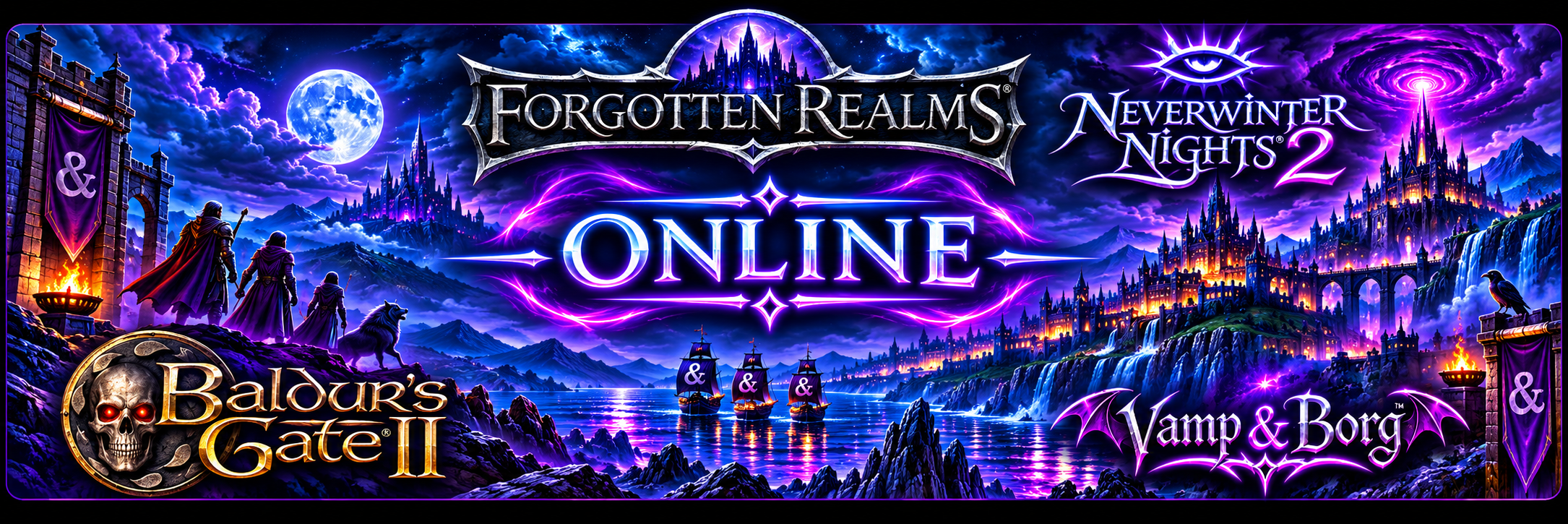
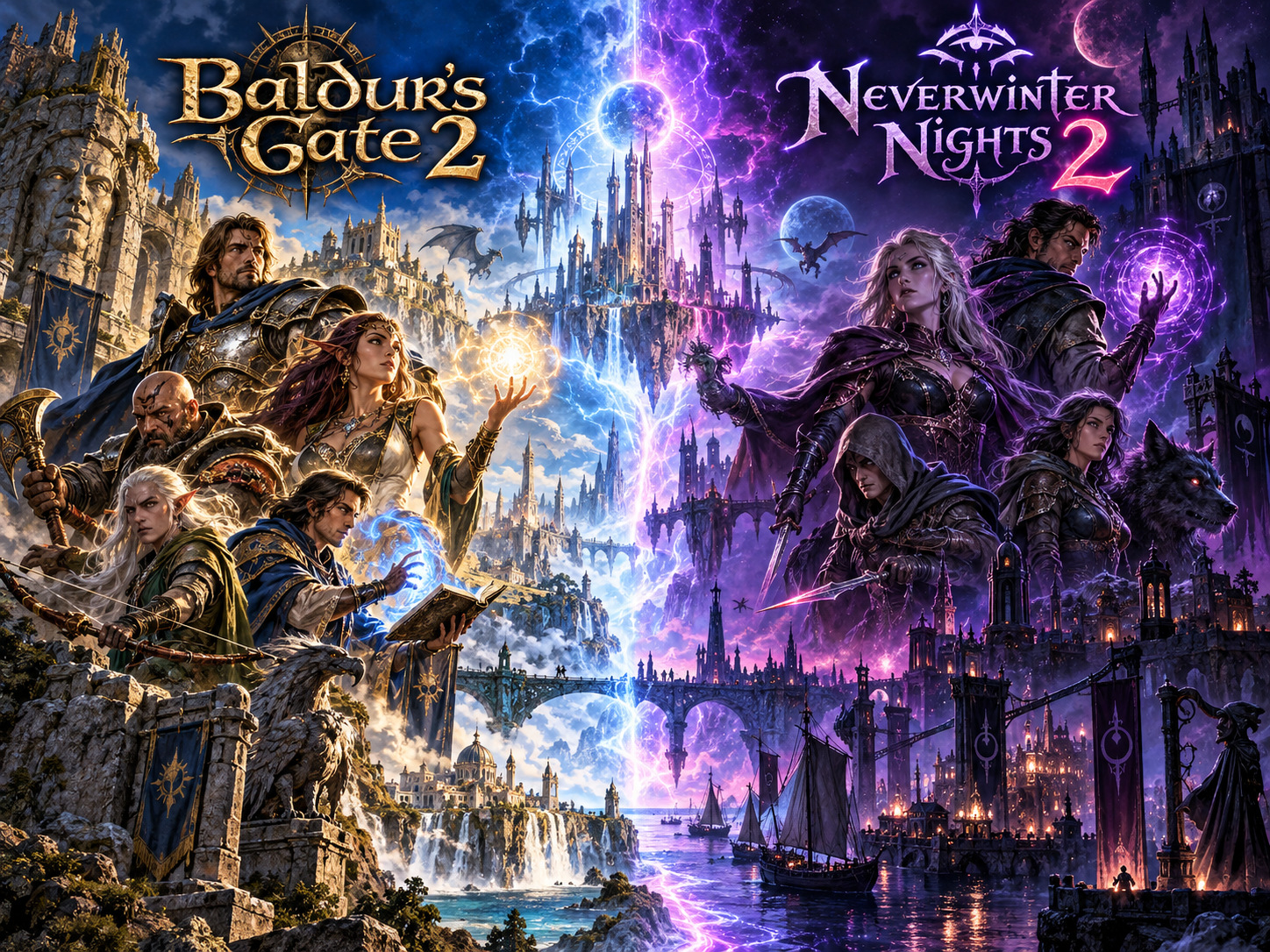
✦
Realm of the Gods 2026-09-19

VAMP & BORG (Latest History)

VAMP & BORG (Latest History)

The Later BORG Era — The Rise and Legacy of BORG_Kronos

From Vamp_Cronos to BORG_Kronos — A Journey of Ambition, Recognition, and Historical Preservation

A Journey That Began with VAMP

My history with VAMP and BORG did not end with the original Baldur's Gate II multiplayer era, nor with my later experiences in Neverwinter Nights: Shadows of the Sword Coast.

Many years earlier, I had been known as Vamp_Cronos, an Ancilla of VAMP who aspired to become a member of BORG.

During that period, BORG represented a level of recognition and technical mastery that I deeply respected. Its members were associated with advanced character editing, sophisticated scripting, and a distinctive approach to multiplayer combat.

I devoted considerable effort to improving my abilities, hoping that one day I might prove myself worthy of joining their ranks.

However, despite my ambitions, I never achieved that goal during the original Baldur's Gate II era.

My journey continued elsewhere.

I eventually became Zerial Solcrisis in Shadows of the Sword Coast, a Neverwinter Nights persistent world connected to the broader VAMP community and its development legacy.

As the years passed, the original GameSpy generation faded, communities dispersed, and much of their history gradually disappeared.

Yet my connection to VAMP and BORG was not entirely over.

BORG_Hawkeye — The Continuation of a Legacy

According to my personal recollections, leadership of the surviving VAMP/BORG lineage eventually passed from BORG_FlashRam to BORG_Hawkeye.

FlashRam had been an important figure in the original multiplayer community. He was remembered as a BORG mentor, the individual who revived VAMP after its original founding by Vamp_Philip, and the creator of Shadows of the Sword Coast.

Hawkeye subsequently became an important figure in the continuation of that legacy.

Years after my original participation in VAMP, BORG_Hawkeye invited me to join BORG.

For me, this invitation carried particular significance.

It represented the fulfillment of an ambition that had remained unresolved since the days when I was Vamp_Cronos.

After so many years, I finally became:

BORG_Kronos.

The player who had once sought admission into BORG as a VAMP Ancilla had eventually earned the opportunity to carry its name.

It was a meaningful moment in my personal history and another chapter in my connection to the old multiplayer community.

The End of My BORG Membership

My membership in BORG, however, did not last permanently.

BORG_Hawkeye eventually removed me from the clan.

Although that decision brought my membership to an end, it did not erase the experiences that had preceded it.

I had begun as a VAMP Ancilla who wanted to prove himself worthy of BORG.

Many years later, I had finally become BORG_Kronos.

Even though that chapter eventually ended, it remained an important part of my journey.

I do not regard my later departure as something that invalidates my history.

The invitation, the membership, and the separation are all parts of the same story.

They represent the changing relationships and circumstances of a community whose history extended across different generations of multiplayer gaming.

Beyond Membership — Preserving the History

Today, my relationship with VAMP and BORG has taken a different form.

I no longer seek to revive these clans by claiming leadership over them or presenting myself as the successor to their former leaders.

My objective is something different.

I want to revive their history.

I want to preserve the names of the people who created, developed, revived, and participated in these communities.

I want to remember Vamp_Philip, the original founder of VAMP, and BORG_FlashRam, who later revived the clan and helped carry its legacy into the Neverwinter Nights generation.

I want to preserve the memories of players such as BORG_Kaos, BORG_DealerOfDeath, BORG_Hawkeye, and the many others whose contributions shaped the competitive and technical culture of the original Baldur's Gate II multiplayer era.

I also want to remember the developers, builders, and Dungeon Masters of Shadows of the Sword Coast, whose work transformed a shared interest in game editing and experimentation into an extensive persistent world.

Much of that history has disappeared with the closure of GameSpy, the loss of old forums, and the disappearance of community websites and privately stored files.

But the memories of those who participated have not entirely vanished.

Their stories deserve to be preserved without exaggeration, without claiming achievements that cannot be verified, and without forgetting the individuals who made those communities meaningful.

The Evolution of Cronos

My own journey through these communities has been marked by several identities.

Each belonged to a different period of my life, but all represent the same continuing history.

GOD_Cronos — My earliest remembered clan identity during the Baldur's Gate II GameSpy era.

↓

Vamp_Cronos — Ancilla of VAMP, devoted to the clan and aspiring to reach BORG.

↓

Zerial Solcrisis — My identity within Shadows of the Sword Coast during the Neverwinter Nights generation.

↓

BORG_Kronos — My later BORG identity, following an invitation from BORG_Hawkeye.

↓

Drakhysys — My present creative identity, through which I seek to preserve this forgotten multiplayer legacy.

These names do not represent separate histories.

They are chapters of the same journey, connected by years of competition, experimentation, personal development, and dedication to the worlds of the Forgotten Realms.

Breath of Fantasy — Keeping the Legacy Alive

Through Breath of Fantasy, I seek to give this history a place where it can be remembered.

My purpose is not to recreate the old clan hierarchy or claim authority over communities that belonged to another generation.

It is to honor their origins, preserve their surviving records, and recognize the people whose knowledge, creativity, and dedication helped shape them.

The original servers may have disappeared.

The GameSpy lobbies may be gone.

The clans may no longer exist as they once did.

But their influence remains part of my personal history.

I was Vamp_Cronos, an Ancilla who once dreamed of becoming BORG.

I later became Zerial Solcrisis, continuing my journey through Neverwinter Nights.

Years afterward, I finally carried the name BORG_Kronos, even though that chapter eventually came to an end.

Today, I am Drakhysys.

And rather than seeking to reclaim a position within the old hierarchy, I choose to preserve the memories of those who came before me and those who shared that journey.

A Legacy Beyond the Clan

To Vamp_Philip, who founded VAMP.

To BORG_FlashRam, who revived it and helped extend its legacy into Neverwinter Nights.

To BORG_Hawkeye, whose invitation finally allowed me to become BORG_Kronos.

And to the players, editors, scripters, builders, and Dungeon Masters whose contributions helped define an unforgettable generation.

I once sought to become part of BORG's history.

Today, I seek to preserve that history.

The names changed. The communities changed. The years passed.

But the memories endured.

Breath of Fantasy is my way of keeping that legacy alive.

Written and preserved by Drakhysys

Formerly GOD_Cronos — Vamp_Cronos — Zerial Solcrisis — BORG_Kronos

Breath of Fantasy — Preserving the Forgotten Realms Multiplayer Legacy

Historical note: The leadership transition from BORG_FlashRam to BORG_Hawkeye, the later invitation to join BORG, and the subsequent end of that membership are preserved through firsthand participant recollections rather than independently verified archival records.

✦
Intro 2026-09-19

LEGENDARY DRAKHYSYS

LEGENDARY DRAKHYSYS

From Audio to Gaming — The Evolution of Drakhysys

From Sound Transformation and Audio Engineering to Software Development, Game Editing, and the Creation of Multiplayer Worlds

The Beginning — A Passion for Sound

My creative and technical development has taken me through several fields, but one of the most important stages of my modern work began with audio editing, sound transformation, and experimentation.

Under the name Drakhysys, I developed a growing interest in understanding how sound could be modified, reconstructed, layered, enhanced, and transformed beyond conventional editing techniques.

For me, audio was never simply about adjusting volume or applying ordinary effects.

It was about exploring the possibilities of sound itself.

I wanted to understand how frequencies, harmonics, modulation, distortion, echoes, spatial positioning, and multiple layers could interact to produce entirely different listening experiences.

This curiosity eventually led me beyond conventional audio-editing software and into developing my own tools.

Audio Editing, Restoration, and Sound Transformation

Through experimentation and practical development, I acquired experience with a wide range of audio-processing techniques.

My work includes:

  • Audio transformation and enhancement: Equalization, compression, normalization, filtering, dynamic processing, and restoration-oriented sound improvement.

  • Creative sound manipulation: Phaser effects, modulation, distortion, pitch shifting, time stretching, reverb, delay, and complex effect combinations.

  • Layered audio processing: Combining multiple sound sources and effect layers while controlling how they interact.

  • Spatial and stereo processing: Stereo positioning, depth, movement, and experimental three-dimensional sound effects.

  • Waveform editing: Selecting individual regions, applying localized transformations, adjusting timing, and manipulating audio segments.

  • Audio reconstruction and remixing: Reworking existing recordings through transformative editing, effects, and layered processing.

  • Audio rendering and export: Working with WAV, MP3, and multimedia formats while considering sound quality, clipping, dynamics, and output compatibility.

One of my central interests became the ability to preserve an original sound source while creating modified versions alongside it.

This principle allowed me to experiment without losing the original material and became an important part of my custom editing systems.

Creating My Own Audio Software

As my requirements became more specialized, conventional audio editors no longer provided every function or workflow I wanted.

Rather than limiting my experiments to existing applications, I began developing custom software.

Using Python, PySide6, FFmpeg, and related technologies, I worked on my own audio-processing environment.

This eventually evolved into the DRAKHYSYS Audio Editor, a custom application designed around my approach to sound transformation.

The editor incorporates concepts such as protected original audio, modifiable audio sources, selected-region processing, effect stacking, sound layering, and experimental audio manipulation.

I also developed a piano-oriented application for sound generation, musical experimentation, recording, and applying effects to synthesized sounds.

These projects required more than knowledge of audio editing.

They introduced me to software architecture, interface design, signal-processing workflows, file handling, debugging, and the challenge of combining multiple technical systems into a usable application.

My creative work was becoming increasingly connected to programming.

Artificial Intelligence and Audio Automation

Another important stage in my development involved experimenting with artificial intelligence as a means of controlling editing software.

I developed an integration between Audacity, Python, and Ollama, allowing natural-language commands to be translated into audio-editing operations.

The objective was to make it possible to describe a desired transformation and have the software interpret that request as a sequence of operations.

This involved command processing, automation, effects management, and interaction with external software.

I also experimented with workflows involving REAPER and the possibility of controlling different audio applications through a shared command system.

These projects strengthened my interest in creating software that could respond to creative instructions rather than relying entirely on traditional menus and manual operations.

It was an important step toward combining artificial intelligence, programming, and creative production.

Expanding Into Video and Multimedia Creation

My audio work eventually expanded into video editing and multimedia development.

I worked on applications capable of arranging audio, images, and video into combined productions.

This included clip manipulation, timeline and track organization, effects processing, media conversion, and exporting finished compositions.

Through the development of the DRAKHYSYS Video Editor, I gained further practical experience with FFmpeg-based multimedia workflows, visual effects, image sequences, synchronization, and video rendering.

My creative environment gradually developed into several connected areas:

Piano and Sound Generation → Audio Transformation → Video and Multimedia Production

Each field introduced new technical challenges.

Together, they expanded my understanding of software development and digital media creation.

The Transition — From Audio Software to Gaming Systems

Although my personal relationship with gaming began much earlier, during the Baldur's Gate II and Neverwinter Nights multiplayer generations, my modern software development followed another path.

The technical experience I developed through audio and multimedia software eventually became useful when I returned to working directly with games.

The skills I had acquired through programming, debugging, automation, file manipulation, and interface development could now be applied to an entirely different environment.

Instead of processing sound sources and managing audio effects, I began working with game resources, character systems, modules, multiplayer configurations, and game-specific file structures.

The underlying approach remained similar.

Understand the system.

Identify its limitations.

Develop tools to modify its behavior.

Test the results.

Improve the implementation.

What had begun with audio transformation evolved into increasingly ambitious game-editing projects.

Baldur's Gate II Online — Rebuilding Multiplayer Possibilities

One of my major gaming projects became Baldur's Gate II Online.

The objective was to develop a customized multiplayer experience supported by a dedicated launcher and account-management system.

My work involved developing and testing features related to player accounts, character ownership, character importing and exporting, session management, multiplayer joining, campaign selection, and game integration.

This required practical experience with:

  • Python application development and graphical interfaces.

  • Launcher architecture and external executable management.

  • Account and character-file organization.

  • Multiplayer session handling and connection workflows.

  • File-system manipulation and game configuration.

  • Debugging, compatibility testing, and iterative software development.

The project also required understanding the limitations of an older game engine and finding ways to improve the surrounding software without unnecessarily disrupting its original functionality.

For me, this represented a continuation of the same philosophy that had guided my audio work.

Rather than simply using existing software, I wanted to understand it and create tools adapted to my own objectives.

Neverwinter Nights 2 Online — Developing a Multiplayer World

My work eventually expanded into Neverwinter Nights 2 Online, a more ambitious project involving game customization, multiplayer hosting, character systems, and world development.

Through this project, I began working with the game's modules, campaigns, resources, configuration files, and server-related systems.

I developed and tested tools for managing game installations, player accounts, launcher behavior, multiplayer connections, and in-game configurations.

One of the most substantial parts of this work became the NWN2 World Editor.

This project focuses on manipulating and combining game content from multiple modules into a larger unified world.

The work involves:

  • Module merging: Combining areas, scripts, creatures, items, placeables, and other resources from multiple modules.

  • Resource conflict management: Identifying duplicate resource names, renaming conflicting files, and maintaining references.

  • World connectivity: Repairing doors, exits, area transitions, and connections between interiors and exteriors.

  • Game scripting: Developing and integrating systems for death, resurrection, creature behavior, and respawning.

  • Multiplayer configuration: Testing server settings, player connectivity, hosting behavior, and account separation.

  • Gameplay customization: Experimenting with character progression, level caps, PvP rules, encounters, and difficulty.

  • Technical troubleshooting: Diagnosing crashes, missing references, invalid resources, scripting failures, and compatibility problems.

My broader goal has been to transform content originating from separate Neverwinter Nights 2 campaigns and modules into a connected multiplayer experience.

This includes experimentation with expanded character progression, including a target level cap of 160, and the development of customized game systems that go beyond the original campaign structure.

✦
Intro 2026-09-19

DRAKHYSYS ULTIMATE LEGENDARY AUDIO EDITOR. (For Pros & Beginners)

DRAKHYSYS ULTIMATE LEGENDARY AUDIO EDITOR. (For Pros & Beginners)

DRAKHYSYS Legendary Audio Editor

A Personal Vision of Sound Transformation, Audio Engineering, and Creative Freedom

Created and developed by Drakhysys — Breath of Fantasy

The Origins — Beyond Conventional Audio Editing

The DRAKHYSYS Legendary Audio Editor was born from my fascination with sound, digital transformation, and the possibilities of audio manipulation.

My objective was never simply to create another conventional audio-editing application.

I wanted to develop an environment where sound could be explored, modified, layered, reconstructed, and transformed with a degree of creative freedom that reflected my own approach to audio experimentation.

Traditional audio editors provide many powerful tools, but I often found myself imagining functions, processing techniques, and workflows that were not available in exactly the form I wanted.

Rather than adapting every idea to the limitations of existing software, I began developing my own.

This decision marked an important stage in my creative and technical journey.

The result became the DRAKHYSYS Legendary Audio Editor, a specialized application built around my vision of sound transformation.

Its purpose is to give me control not only over individual effects, but also over the way audio sources, transformations, and processing layers interact.

My Philosophy — Preserve, Transform, and Experiment

One of the most important principles behind my editor is the preservation of original audio.

I wanted to be able to experiment extensively without permanently destroying the source material.

For this reason, the editor uses a system built around two complementary audio sources:

Unmodifiable Audio — The protected original source, retained as a reference throughout the editing process.

Modifiable Audio — The editable version of the source, where transformations, processing, layering, and creative manipulation can be applied.

This separation allows the original recording to remain available while the modifiable version undergoes extensive changes.

It also makes it easier to compare the source with its transformed counterpart.

For me, this distinction is fundamental.

An audio editor should provide the freedom to experiment while retaining control over the material being transformed.

The original sound remains the foundation. The modifiable sound becomes the creative instrument.

Layered Audio — Building Sound Through Transformation

One of the defining characteristics of the DRAKHYSYS Legendary Audio Editor is its approach to layered processing.

Rather than limiting audio manipulation to a single destructive sequence of effects, the editor supports the combination of multiple transformations.

Its processing workflow includes concepts such as Stack, Replace, Repeat Stack, and additive layering.

These functions provide different ways of applying and combining transformations.

Stacking allows processed sound to be combined with existing material, while replacement operations allow selected material to be substituted with a newly processed version.

Repeated stacking makes it possible to explore more elaborate combinations.

Individual effects can also be managed independently, allowing selected processing components to be bypassed without necessarily discarding the rest of the work.

This approach is particularly useful for complex transformations involving echoes, delays, modulation, distortion, and spatial effects.

Sound is no longer treated simply as one continuous waveform.

It becomes a collection of interacting elements that can be manipulated creatively.

Precision Editing — Transforming Individual Passages

Another important objective was to provide precise control over selected audio regions.

I wanted to apply transformations to particular passages without unnecessarily affecting the remainder of a recording.

The editor therefore incorporates selected-field and region-based editing.

This allows operations such as cutting, cropping, copying, manipulating, or applying effects to specific sections of audio.

Selected regions can be processed independently, while the surrounding material remains preserved.

The ability to work at this level of precision is particularly valuable when experimenting with short passages, rhythmic sequences, transitions, or individual sound events.

It also supports a more controlled editing workflow.

Instead of processing an entire recording every time I want to modify one element, I can concentrate on the section that requires attention.

Effects Processing — A Laboratory for Sound

The DRAKHYSYS Legendary Audio Editor incorporates a broad range of creative sound-processing functions.

These effects are intended not only for conventional enhancement, but also for more experimental transformations.

Among the areas I have explored are:

  • Phaser and modulation effects — Creating movement, phase variation, and evolving sound textures.

  • Echo and delay processing — Producing repetitions, decays, rhythmic patterns, and layered reflections.

  • Reverberation — Experimenting with perceived space, resonance, and acoustic depth.

  • Pitch and tonal transformation — Altering the character and tonal properties of audio.

  • Speed manipulation — Changing playback speed with different approaches to pitch and tonal preservation.

  • Filtering and equalization — Adjusting frequency content and emphasizing or reducing selected spectral regions.

  • Distortion and saturation-style effects — Exploring the interaction between harmonic intensity and sound character.

  • Stereo and spatial processing — Modifying perceived positioning, width, movement, and depth.

  • Dynamic and intensity processing — Controlling signal levels and experimenting with the impact of layered effects.

These functions can be combined to produce transformations that go beyond the sound of any individual effect.

The objective is not simply to increase the number of available effects.

It is to provide an environment in which they can interact in flexible and creative ways.

Intensity Pillar — Experimenting with Sound Density

Among the specialized concepts developed for the editor is the Intensity Pillar.

This system forms part of my experimentation with controlling and shaping the intensity of processed audio.

Related functions, including Copy Pillar, extend the ways in which particular processing characteristics can be applied or reused.

The intention is to provide more creative control over the perceived power, density, and structure of audio transformations.

These tools reflect one of the central ideas behind my development process: creating specialized functions that correspond to my own experimentation rather than relying exclusively on standard editing conventions.

Speed Transformation and Tonal Preservation

Speed manipulation became another important part of my audio-editing research.

Changing the speed of a recording can affect its pitch, duration, and perceived tonal characteristics.

I wanted different ways of controlling those relationships.

The editor therefore includes processing approaches identified as Speed Care / Natural Tone and Speed Keep Tone.

These functions are designed around different approaches to changing audio speed while managing tonal behavior.

They allow experimentation with timing and duration without requiring every speed change to follow the same processing method.

This is especially useful for creative sound transformation, where preserving the original tonal character and deliberately changing it are two different objectives.

Three-Dimensional and Spatial Audio

Another major area of development has been spatial sound processing.

I wanted to experiment with the perception of sound movement, positioning, width, and depth.

This led to a collection of spatial-processing behaviors designed to interact with the stereo field and perceived acoustic environment.

In advanced builds, the editor incorporates 25 independently controllable spatial behaviors, with the ability to bypass individual components.

Because combining many spatial effects can create excessive intensity or conflicting processing, the system also incorporates strategies for managing effect interactions and audio levels.

These include attention to signal density, overlapping effects, RMS and peak behavior, and containment of excessive output levels.

My goal is not to claim that every transformation reproduces a physically accurate three-dimensional environment.

Rather, it is to explore how different processing techniques can influence the listener's perception of space.

For me, spatial audio is another field of creative experimentation.

Sound Quality and Rendering

Developing complex audio-processing systems also requires attention to rendering quality.

When multiple transformations are applied to the same material, maintaining control over signal levels and avoiding unwanted clipping become important technical challenges.

My editing and export workflows have involved experimentation with floating-point processing, higher-precision intermediate calculations, oversampling, loudness analysis, peak management, and output conversion.

Advanced export workflows also incorporate format verification and mastering-oriented options.

These functions are intended to support reliable rendering while allowing complex transformations to be combined.

The editor also uses memory-oriented rendering techniques with disk-based fallback strategies for demanding operations.

This reflects the technical side of developing audio software: creative effects must be supported by a processing system capable of handling the resulting audio data.

Piano, Sound Generation, and Musical Experimentation

My audio projects also expanded into piano-based sound creation.

Within the broader DRAKHYSYS editing environment, I developed piano functions and a dedicated Piano Editor for generating, combining, and manipulating musical sounds.

This work involves synthesized note waveforms, chords, arpeggios, sound recording, and layered effects.

The piano environment provides another way of creating material that can be transformed through audio processing.

Rather than relying entirely on imported recordings, it allows sound to be generated and manipulated directly.

Piano functionality has also been integrated into certain editor builds, while the dedicated Piano Editor remains part of the broader software family.

This connection between sound generation and sound transformation has become an important aspect of my creative approach.

Programming My Own Audio Environment

The development of the DRAKHYSYS Legendary Audio Editor required me to work across several technical disciplines.

My software development has involved Python, PySide6, FFmpeg, audio-processing routines, graphical interfaces, file handling, and application architecture.

I have worked on interface systems for managing effects, processing audio regions, controlling playback, organizing sources, and exporting finished results.

The challenge was not simply to make individual effects work.

It was to integrate them into a coherent editing environment.

Each new feature had to interact with the existing system without unnecessarily disrupting other functions.

This required extensive testing, debugging, revisions, and attention to compatibility.

Over time, the editor evolved through many development versions, each introducing improvements, additional functions, or changes to its processing behavior.

The software became both a creative instrument and an ongoing programming project.

Artificial Intelligence and Audio Automation

My interest in software development also led me to explore natural-language control of audio-editing operations.

In related experiments, I worked with Python, Audacity, and Ollama to develop a system in which editing instructions could be interpreted and translated into operations.

The intended workflow connected user commands with audio-editing software through a controller and processing bridge.

These experiments explored the possibility of making audio editing more accessible through written instructions, including commands directed at particular tracks or selected regions.

The objective was to investigate how artificial intelligence could assist with repetitive operations and more complex editing workflows.

This experimentation formed part of my broader interest in combining creative software with automation.

Importing, Exporting, and Media Compatibility

The editor has also been developed around practical media-handling requirements.

Its workflows include importing, previewing, processing, and exporting audio using common file formats.

Supported editing and export workflows have involved WAV, MP3, and MP4-related media operations.

The application includes Save Audio and Save Media functions, alongside specialized rendering and export options.

Advanced export development has also included 24-bit WAV output and MP4-oriented mastering options.

One specialized export workflow, known as MP4 Mob, focuses on final rendering and mastering rather than functioning as an ordinary real-time playback effect.

These capabilities allow my sound experiments to move beyond the editor and become usable media outputs.

The Relationship with My Other Editors

The DRAKHYSYS Legendary Audio Editor is part of a broader creative software environment.

Alongside the main audio application, I developed a dedicated Piano Editor and a separate Video Editor.

Each application concentrates on a different aspect of creative production.

The Audio Editor focuses on sound transformation, layering, precise editing, and effects processing.

The Piano Editor focuses on sound generation, musical experimentation, recording, and note-based creation.

The Video Editor expands the workflow into visual media, combining video, images, audio, and effects within a multi-lane editing environment.

Together, these projects reflect my interest in building tools that can support different stages of creative production.

They also demonstrate how my software development gradually expanded beyond audio processing alone.

More Than an Audio Editor — A Personal Research Project

The DRAKHYSYS Legendary Audio Editor represents much more to me than a collection of effects or a conventional editing application.

It is the result of experimentation, programming, problem-solving, and the desire to create an environment suited to my own artistic objectives.

Many of its features originated from questions I asked while working with sound.

What if an effect could be stacked repeatedly without replacing the original source?

What if I could apply a complex transformation to a single passage while leaving the rest untouched?

What if spatial effects could be controlled individually within a larger processing system?

What if I could combine sound generation, transformation, rendering, and software automation into a more connected workflow?

Each of these questions encouraged further development.

Some ideas became implemented functions.

Others required substantial revision or continued experimentation.

The editor therefore represents an evolving technical project rather than a fixed collection of completed features.

Its development has helped strengthen my knowledge of signal processing, application design, multimedia handling, programming, and debugging.

Most importantly, it has allowed me to turn creative ideas into functioning software.

Breath of Fantasy — The Identity Behind the Project

Under Breath of Fantasy, the DRAKHYSYS Legendary Audio Editor forms an important part of my creative work.

It reflects my interest in transforming existing material, exploring unconventional processing techniques, and developing tools that provide greater control over artistic experimentation.

The same interests that guided my work in audio eventually expanded into multimedia editing and game development.

My experience with audio-processing systems became useful when developing more complex applications, including game launchers, world editors, and multiplayer tools.

Although the objectives of audio editing and gaming are different, the underlying development process shares many similarities.

Both require understanding how systems operate.

Both involve manipulating structured resources.

Both depend on careful testing, debugging, and refinement.

And both provide opportunities to create something different from the original material.

For me, the DRAKHYSYS Legendary Audio Editor represents an important stage in that broader journey.

It helped transform my interest in sound into practical software development experience.

The Continuing Evolution of DRAKHYSYS Legendary Audio Editor

My objective has never been to declare the editor finished simply because a particular version works.

Creative software can always be refined.

Processing methods can be improved, workflows simplified, and new ideas explored.

The development of this application has taught me that even a seemingly small feature can require a considerable understanding of how different components interact.

Through repeated experimentation, I have learned to approach these challenges with greater technical awareness.

The editor continues to represent my interest in developing software that reflects my own creative needs.

I do not regard it merely as an alternative to existing audio editors.

I regard it as a personal instrument for experimentation, transformation, and creative production.

DRAKHYSYS Legendary Audio Editor — A Vision of Creative Freedom

An original sound can become the foundation of countless transformations.

An individual effect can become part of a complex processing structure.

A single selected passage can become an entirely different listening experience.

And an idea that begins as a creative experiment can eventually become a functioning software tool.

The DRAKHYSYS Legendary Audio Editor was created from that philosophy.

It represents my continuing exploration of sound, programming, technology, and creative independence.

It is not simply about editing audio.

It is about understanding sound, transforming it, and discovering what can be created beyond conventional limitations.

DRAKHYSYS Legendary Audio Editor

Created and developed by Drakhysys

Breath of Fantasy — Audio Engineering, Sound Transformation & Creative Software Development

Preserve the Original. Transform the Sound. Explore the Possibilities.

⬡
Downloads 2026-11-10

NWN2 LAUNCHER V35

NWN2_PLAYER_V35.zip 1.2 GB Downloads: 1
⬡
Downloads 2026-11-10

BG2 LAUNCHER

BG2.zip 151.0 MB Downloads: 0
⬡
Echoes of Eternity 2026-11-08

Drakhysys Audio Editor

Updated to Final Version

DRAKHYSYS_LEGENDARY_AUDIO_EDITOR_User.zip 212.1 MB Downloads: 0
⬡
Lore of The Ancients 2026-10-13

Drakhysys Ultimate Baldur's Gate II God Editor

This is an incredible powerful editor for making his own campaigns in Baldur's Gate II and create new horizons for the players and the creator as well.

All_Editors_V452_CREATURE_FACTORY_ALL_LANGUAGES_FROZEN.zip 1.9 MB Downloads: 3
⬡
Echoes of Eternity 2026-10-13

Drakhysys Audio Editor

Updated to the last version.

Drakhysys Audio Editor Users.zip 211.1 MB Downloads: 3
⬡
Lore of The Ancients 2026-09-28

Drakhysys Bam Creator Sources Folders

This is a folder creator for bams files wich are required to make animations, it work with each image positions and movements by AI to execute inside theses folders that you can import throught the creature animation editor.

DRAKHYSYS DIRECTION EMPTY BEHAVIOR.zip 34.1 KB Downloads: 4
⬡
Lore of The Ancients 2026-09-26

Java Runtime Environement

This is the javaruntime environement used to make NearInfinity Engine work and other Programs Related.

jre-8u503-windows-x64.exe 69.0 MB Downloads: 6
⬡
Lore of The Ancients 2026-09-26

Near Infinity Engine

This is an ancient editor of decades for Baldur's Gate II and other Near Infinity Engines.

NearInfinity.jar 9.3 MB Downloads: 6
✦
Echoes of Eternity 2026-11-10

What I've Done-Linkin Park

Download disabled Downloads: 0
✦
Echoes of Eternity 2026-11-10

I Love You-Slipknot

Download disabled Downloads: 0
✦
Vision of Eternity 2026-11-09

Drakhysys-NWN2 Online Infinity-Warlock Wraith-Ascended

Download disabled Downloads: 0
✦
Echoes of Eternity 2026-11-09

The Catalyst-Linkin Park

Download disabled Downloads: 0
✦
Vision of Eternity 2026-11-09

Drakhysys-Neverwinter Nights 2 Online Infinity-Warlock Death Knight-Ascended

Download disabled Downloads: 0
✦
Echoes of Eternity 2026-11-08

Easier to Run-Linkin Park

Download disabled Downloads: 0
✦
Echoes of Eternity 2026-11-08

Burn it Down-Linkin Park

Download disabled Downloads: 0
✦
Vision of Eternity 2026-11-07

Drakhysys-Neverwinter Nights 2 Online Infinity-Exploring New Horizons

Download disabled Downloads: 0
✦
Street Fighters 6 2026-11-07

Drakhysys-Street Fighters 6-Chun Li

Download disabled Downloads: 0
✦
Vision of Eternity 2026-11-07

Drakhysys-Neverwinter Nights 2 Online Infinity

Download disabled Downloads: 0
✦
Echoes of Eternity 2026-11-06

Forgotten-Linkin Park (Remastered By Drakhysys)

Download disabled Downloads: 0
✦
Echoes of Eternity 2026-11-06

Lying From You-Linkin Park (Remastered By Drakhysys)

Download disabled Downloads: 0
✦
Echoes of Eternity 2026-11-06

Numb-Linkin Park (Remastered By Drakhysys)

Download disabled Downloads: 0
✦
Echoes of Eternity 2026-11-06

My December-Linkin Park (Remastered By Drakhysys)

Download disabled Downloads: 0
✦
Echoes of Eternity 2026-11-05

Sia

Download disabled Downloads: 0
✦
Echoes of Eternity 2026-11-05

Erobx – That Last Goodbye (Linkin Park Inspired)

Download disabled Downloads: 0
✦
Echoes of Eternity 2026-11-05

God of Storm & Kaos-Drakhysys

Download disabled Downloads: 0
✦
Echoes of Eternity 2026-11-05

The Rapsody-Warren G & Sissel - Prince Igor

Download disabled Downloads: 0
✦
Echoes of Eternity 2026-11-01

Nirvana-Heart Shaped Box

Download disabled Downloads: 0
✦
Echoes of Eternity 2026-10-20

Waiting for the End-Linkin Park

Download disabled Downloads: 0
✦
The Ancient Faerûn 2026-10-14

Drakhysys-Baldur's Gate 2 Online-Shadows of Amn Campaign

Download disabled Downloads: 0
✦
Echoes of Eternity 2026-10-13

Iridescent-Linkin Park

Download disabled Downloads: 0
✦
Echoes of Eternity 2026-10-13

Cyber Crusader-Drakhysys

Download disabled Downloads: 0
✦
Echoes of Eternity 2026-10-13

Fall & Rise 2-Drakhysys

Download disabled Downloads: 0
✦
Echoes of Eternity 2026-10-13

Fall & Rise-Drakhysys

Download disabled Downloads: 0
✦
Echoes of Eternity 2026-09-28

Osmos'99-Mass Hysteria

Download disabled Downloads: 0
✦
Echoes of Eternity 2026-09-27

Remède-Mass Hysteria

Download disabled Downloads: 0
✦
Lore of The Ancients 2026-09-27

Drakhysys's Baldur's Gate 2 Areas

Download disabled Downloads: 0